
Contributing authors Josephina Green, Isabelle Song, and Lara Taylor are students at Northeastern University.
VoCA is pleased to present this blog post in conjunction with Associate Professor of Contemporary Art History Gloria Sutton’s Spring 2026 course, Edit Filter, Curate: Cultural Production in the Digital Sphere. The seminar explores how cultural production operates within the public sphere through practices of editing, curating, and online dissemination.
In Magical Thinking, of Systems and Beliefs, Tufts University Art Gallery Curator Laurel V. McLaughlin brings together six artists whose art practice explores forms of knowledge that exceed—or actively challenge—the frameworks of Western rationalism. Conceived as a multipart research initiative spanning a symposium, exhibition, and forthcoming publication, Magical Thinking, of Systems and Beliefs uses the term “magical thinking” not as pedagogy or a counter model to academic methods, but as a way to consider how ritual, speculation, and other “alogical” modes of thought shape contemporary life. Across sculpture, installation, and time-based media, artists manuel arturo abreu, DB Amorin, Jonathan González, fields harrington, Africanus Okokon, and Sidony O’Neal prompt viewers of the exhibition to reconsider what it means to “know” something in the present.
In the conversation that follows, McLaughlin reflects on her curatorial practice as a form of “conduction” or cultural transmission, the challenges of presenting speculative and nonrational ways of knowing within institutional contexts, and the possibilities of experimenting alongside the artists in the exhibition to open up rather than define the term “magical thinking.” The exhibition was on view at Tufts University Art Galleries (TUAG) at the School of the Museum of Fine Arts (SMFA) from January 29th through April 19th, 2026.
In what ways has your interdisciplinary background shaped your curatorial approach, particularly in developing Magical Thinking, of Systems and Beliefs?
McLaughlin: My scholarly and curatorial work draws from art history, performance studies, cultural studies and that interdisciplinarity has been formative for how I think about curating. My experiences working at institutions like the Philadelphia Museum of Art, ICA Philadelphia, and the Pennsylvania Academy of the Fine Arts, as well as my independent curatorial work across different regions, have all contributed to how I understand exhibitions as sites of dialogue.
I think of curating less as a fixed position and more as a form of conduction. That is, a process that moves between artists, institutions, and publics—facilitating exchanges that are not always fully visible, but that nonetheless produce change. Conduction, in a material sense, is the transmission of energy between entities. That idea became a useful way of thinking about the exhibition itself.
I had been working closely with artist manuel arturo abreu to consider how the concept of “magical thinking” was a form of knowledge production that operates seemingly beyond logic. We were interested in how something like “conduction” might function as an unseen or esoteric force, and how that might map onto artistic practices that resist straightforward explanation.
The project ultimately took a tri-partite form: a symposium at MASS MoCA, the exhibition at TUAG, and a publication. Across these formats, we wanted to step back from defining magical thinking too rigidly, and instead observe the kinds of relationships to knowledge it produces. That meant creating a structure that was interdisciplinary and multi-vocal, allowing different forms of inquiry to coexist.
The term “magical thinking” is often used dismissively in Western contexts. What drew you to reclaim—or repurpose—it in this exhibition?
McLaughlin: We were drawn to the instability of the term. It carries very different meanings across psychology, anthropology, and cultural theory, and in many Western contexts it’s used to describe something irrational or naive. That denigrated quality was both troubling and generative for us. Rather than rejecting that history outright, we were interested in repurposing and expanding the term, as manuel’s work has done over the past decade. Instead of defining “magical thinking” too narrowly, we wanted to explore what kinds of possibilities emerge if we hold the term open.
For example, manuel’s sculptural installation, Untitled (Herramienta) (2014) stages a speculative encounter between everyday materials, technological remnants, and ritual forms. Composed from found “functional” objects—an office chair base, USB cables, beeswax candles, fake flowers, and coffee grounds—the work resists the European origin myth of abstraction by grounding formal experimentation in Black and brown embedded abstraction and spiritual residue. The piece operates less as a fixed argument than as a charged arrangement of disparate parts: materials accumulate as traces of labor, circulation, obsolescence, and care. Its low-to-the-ground composition and provisional logic invite viewers to move through association rather than certainty.
That approach resonates strongly with the broader framework of the exhibition. Across the works included, artists examine colonial infrastructures, diasporic histories, technological systems, and spiritual practices in ways that challenge dominant Western frameworks of evidence and rationality. Rather than offering stable forms of knowledge, these works ask viewers to consider what other epistemologies—intuitive, embodied, speculative, ancestral—might become available in the present.
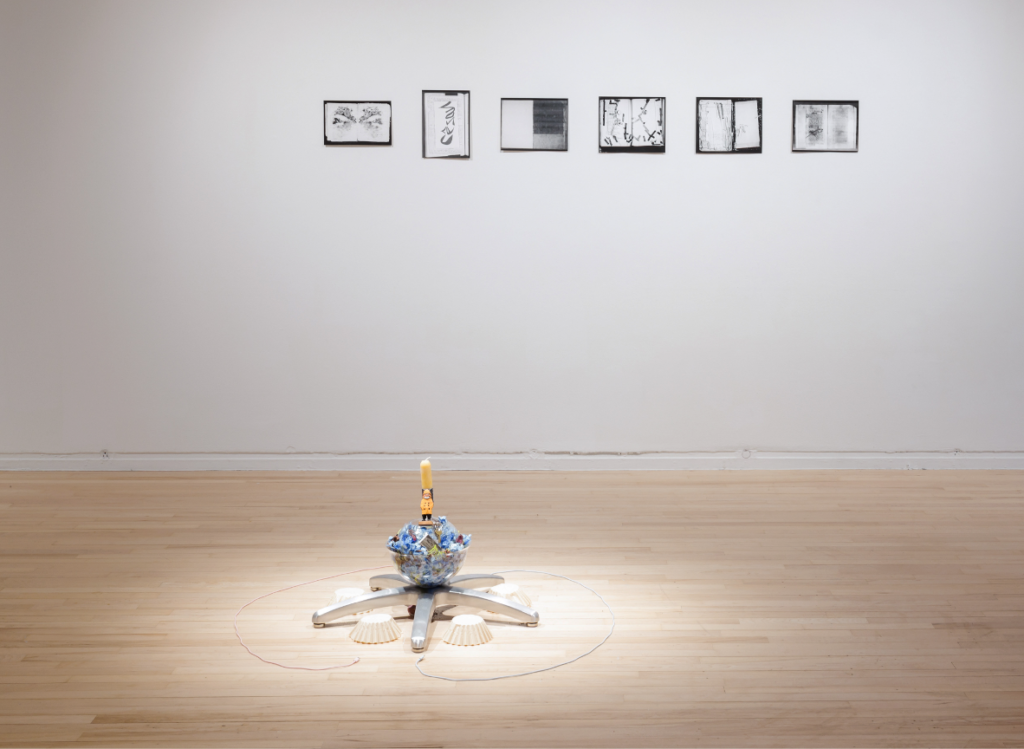
manuel arturo abreu, Untitled (Herramienta), 2014. Glass, office chair base, USB cables, beeswax candle, fake flowers, found figurine, matchbooks, C alkaline battery, coffee filters, rum, chocolate, coffee grounds, keys, sweet potato. Installation View, Magical Thinking, of Systems and Beliefs, January 29–April 19, 2026, Tufts University Art Galleries / Boston, MA. Photo: Tim Correira.
There are risks in staging work like manuel’s and other artists whose work takes a more open ended, speculative approach within a university gallery setting. How did you think about those risks inside and outside of the gallery space?
McLaughlin: Yes, absolutely. There are several layers of risk. One is that by holding the term “magical thinking” open, we risk it being defined for us—reabsorbed into the very frameworks we’re trying to question. There’s also the challenge of presenting forms of knowledge still in formation within institutional contexts that often prioritize clarity, measurability, and instrumentalized outcomes. This exhibition resists that.
Another aspect to consider is the broader cultural context. In a moment marked by renewed authoritarianism, by skepticism toward technological progress, and by a growing interest among younger generations in spiritual or non-material frameworks, the turn toward what might be called “the alogical” feels significant. But it also risks being dismissed as utopian or even misinformative.
At the same time, I would argue that this is precisely the kind of thinking students need to engage with right now. Not as an alternative to critical analysis, but as an expansion of what counts as knowledge.
The artists engage themes like colonial extraction, technological infrastructure, and diasporic history. Do you see their inclusion as reconfiguring dominant frameworks, or does the inclusion of their artworks within an institutional context risk reproducing them?
McLaughlin: I think it’s both. The artists are absolutely proposing new ways of thinking through their practices. But at the same time, the institution is not neutral. As philosopher Frederic Jameson famously noted, capitalism has an extraordinary capacity to absorb critique. The art world operates within those logics, and this exhibition is not exempt from that.
So yes, there is always the possibility that these works are reabsorbed—through discourse, through circulation, through the market. But that doesn’t mean we stop making space for conversations that unapologetically challenge these systems and imagine ones beyond it.
As a curator, I think of my role as creating conditions where these critiques can be encountered—where alternative ways of thinking can be articulated, even if they are not fully resolved. That, for me, is a form of resistance.
The exhibition brings together artists working across very different materials, references, and conceptual frameworks. How did you think about constructing relationships between the works within the gallery space?
McLaughlin: It was a combination of factors. The spatial constraints of the Boston galleries at SFMA always play a role—they shape what’s possible. But within those constraints, I was thinking about both resonance and tension. There are moments where works are paired because of formal affinities; for example, fields harrington’s, Monkey Bar/Lab Support Stand (2023) and manuel’s Untitled (Herramienta) (2017-ongoing), which are both sculptural forms created from functional or discarded objects. Harrington’s work combines the visual language of laboratory apparatus and playground equipment, producing a structure that feels simultaneously industrial, improvised, and bodily. In contrast, manuel’s floor-based installation gathers materials into a quiet but charged composition. Although formally distinct, both works transform utilitarian materials into speculative propositions about knowledge, labor, and embodied experience.
There are also pairings that draw out shared concerns, such as DB Amorin and Sidony O’Neal’s engagement with technological infrastructures in the Global South. Both artists examine how systems of extraction, circulation, and digital mediation shape everyday life, though through very different visual strategies—Amorin through layered references to nuclear histories and networked technologies, and O’Neal through works that foreground the social and material conditions embedded within contemporary media systems.
At the same time, there are productive tensions. For instance, placing Africanus Okokon’s Fire (picture disc) (2026) alongside Amorin’s work creates a contrast between different temporal and epistemological orientations—ancestral knowledge on the one hand, and the ongoing reverberations of nuclear testing on the other. I was interested in allowing those relationships to remain open, rather than resolving them into a single narrative.
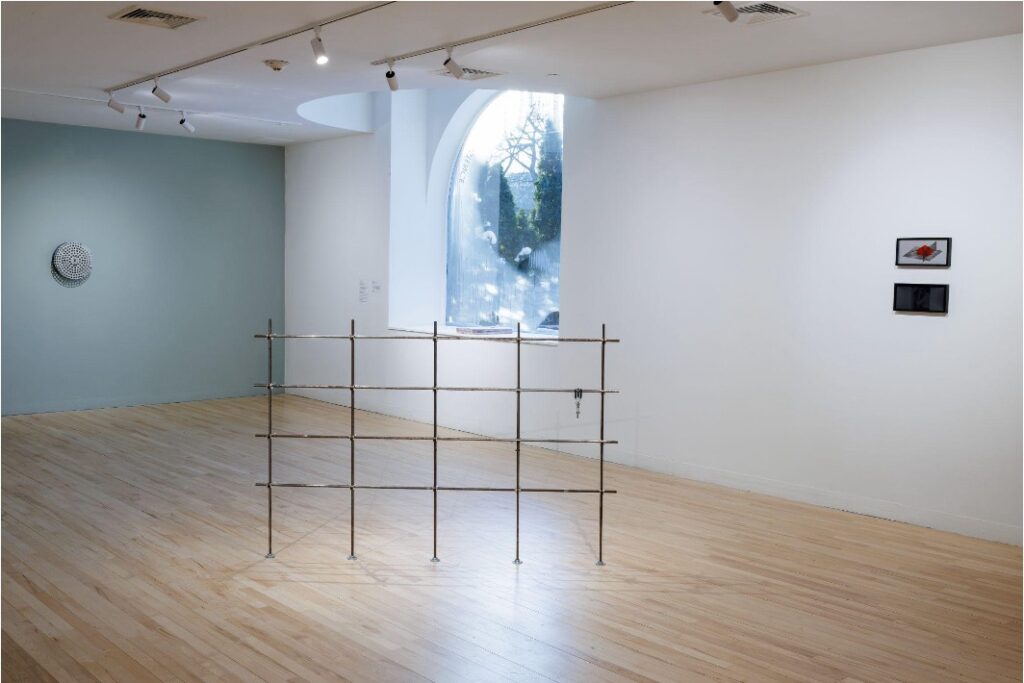
Installation view, fields harrington, Monkey Bar/Lab Support Stand, Magical Thinking, of Systems and Beliefs, January 29–April 19, 2026, Tufts University Art Galleries / Boston, MA. Photo: Tim Correira.
How did the physical layout of the SMFA gallery support these relationships?
McLaughlin: The space is always a collaborator, whether you want it to be or not. At times, the Boston galleries at SMFA support the kinds of relationships I’m trying to draw out, and at other times they present challenges.
Issues like flow between galleries, wayfinding, and signage are always factors. You’re constantly negotiating between your curatorial intentions and the realities of the space. But I try to think of those constraints as generative. They shape the exhibition in ways that might not have been anticipated.
The exhibition engages Western institutional frameworks while being staged within one. How did you navigate that tension?
McLaughlin: That tension is very much at the core of the exhibition. SMFA, like many institutions in the U.S., is rooted in Enlightenment traditions and connected historically to encyclopedic museums like the MFA Boston. At the same time, SMFA has a history of experimentation—through its interdisciplinary curriculum and critique-based pedagogies. That creates space for projects that challenge institutional norms.
In Magical Thinking, I was interested in holding that tension in place rather than resolving it. For instance, fields harrington’s Propagate at Two Revolutions Per Hour (2023) and Surreptitious Spread (Ventilation Series) (2023) examine how scientific inquiry operates through systems of production and reproduction tied to extraction, containment, and colonial expansion within and upon the Black body. The works also point to the ways corporate and governmental funding structures shape research practices and institutional frameworks, raising broader questions about the values embedded within scientific and museological practices.
These gestures don’t overturn the institution, but they do create moments of friction. They ask: what are the limits of what can be shown, and how? For students and educators, these tensions can be productive. They create opportunities to question assumptions about what art is, what knowledge looks like, and how it is transmitted.
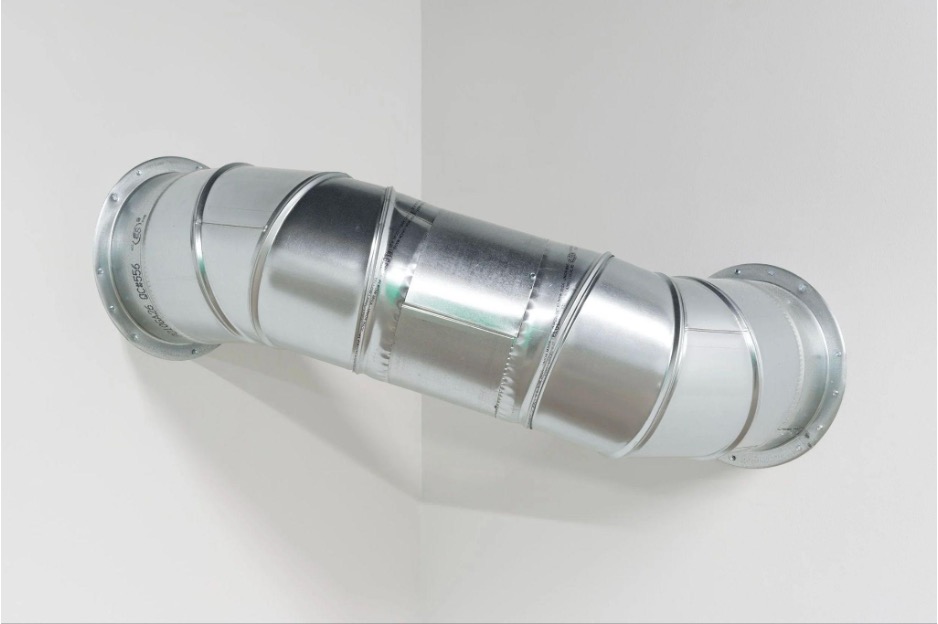
fields harrington, Surrepticious Spread (Ventilation Series) (2023). Aluminium, Round Air Duct and hardware. Photo: fields harrington.net
Jonathan González’s work takes place at the African Meeting House rather than within the gallery. What did it mean to extend the exhibition beyond the institution?
McLaughlin: With its long history as a site of refuge and activism, The African Meeting House was integral to González’s suite for a minor meeting (2026). The performance was inspired by the abolitionist movement and key figures in Boston’s Black Community, so that collaboration was incredibly important. Working with the Museum of African American History, and specifically with the Chief Curator & Director of Collections Angela Tate, opened up new ways of thinking about the project.
The African Meeting House is not just a site—it’s an active participant. The performance involved engaging directly with the architecture, tracing the building, recognizing it as a kind of living archive. By situating part of the work there, we created a bridge between institutions and histories that are often siloed. It also encouraged students and audiences to engage with Boston’s Black history in a more direct way. For me, it shifted how I think about curating in the city—not as confined to individual institutions, but as something that can move between them.
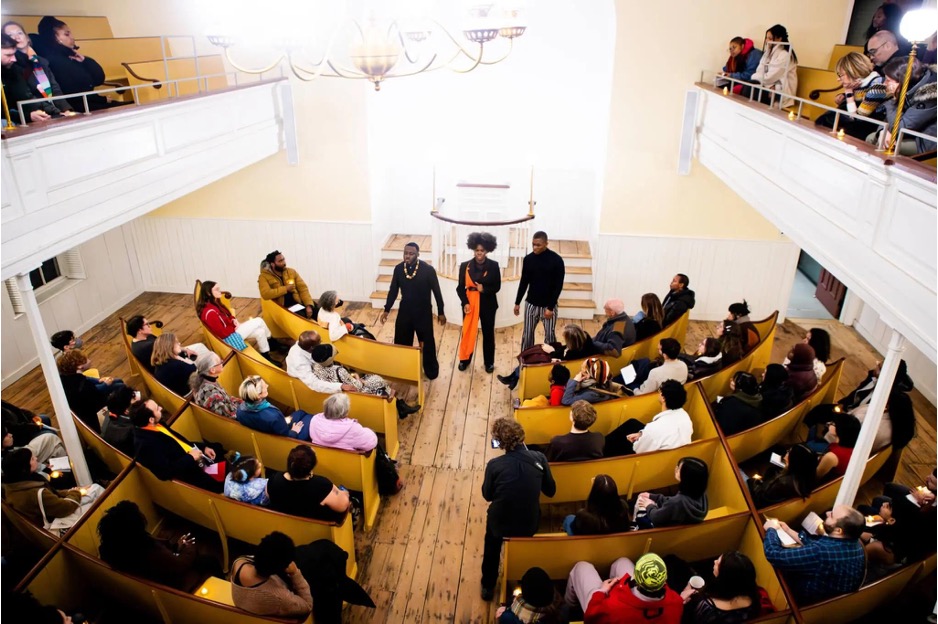
Performance view of Jonathan González with Ogechi Okoye, Ifeanyi Epum, Valentine Umeh, suite for a minor meeting, February 28, 2026, African Meeting House, Museum of African American History and Tufts University Art Galleries. Photo: Cat Lent (Boston Art Review).
VoCA’s mission emphasizes stewardship. How do you understand the curator’s role as a steward in this context?
McLaughlin: I do think of curators as stewards—not just of objects, but of relationships, ideas, and processes.
That stewardship extends in multiple directions: toward artists, toward audiences, toward institutions, and toward the work itself as it takes on new meanings over time. The term “curator” comes from curare, to care for. While I don’t presume to heal in the fullest sense of that word, I do think care is central to the work. At TUAG, stewardship also means thinking about how projects continue beyond the exhibition. For Magical Thinking, that takes the form of a publication—a “reader” rather than a catalog. That distinction is important to me. The book is not just a record of the exhibition; it’s an extension of the conversation with participating artists, alongside S*an D. Henry-Smith, M. NourbeSe Philip, Emilio Rojas, and Rebecca Schneider. It includes essays, scripts, image-based work, and poetry with design by Jon Santos—multiple forms that reflect the project’s interdisciplinary nature.
In that sense, stewardship is about sustaining dialogue—creating conditions for ideas to continue evolving over time.