
Contributing authors Sage Antonio, Quinn Chen Phang, Ryan Coffey, Josephina Green, Soojin (Lucy) Lee, Hoa Hong Ly, Sasha Marmur, Naseem Mohideen, Hyerin Park, Thalia Rebello, Svetlana Russell, Isabelle Song, Lara Taylor, Julia Vazquez, Andrew Wallace, and Leah Wirley are students at Northeastern University.
VoCA is pleased to present this blog post in conjunction with Associate Professor of Contemporary Art History Gloria Sutton’s Spring 2026 course Edit, Filter, Curate: Cultural Production in the Digital Sphere. The seminar explores how cultural production operates within the public sphere through practices of editing, curating, and online dissemination.
This is Part 2 of an in-depth interview with Jeffrey De Blois, Mannion Family Curator at the Institute of Contemporary Art Boston, whose exhibition Say It Loud: AAMARP, 1977 to Now (February 12–August 2, 2026) offers a sustained engagement with the African American Master Artists-in-Residence Program (AAMARP). Founded in 1977 by artist, educator, and activist Dana C. Chandler Jr. (1941-2025), AAMARP is one of the longest-running residency programs for Black artists in the United States. To read Part 1, click HERE.
When a resistance-based initiative like AAMARP enters a museum, who ultimately controls the narrative—the artists, the curator, or the institution?
De Blois: It’s a complicated question, and I don’t think there’s a single answer. I was entrusted by Dana Chandler to help tell this story, and I take that responsibility very seriously.
At the same time, the narrative is not something that belongs to me in any absolute sense. It emerges out of multiple sources—the archive, the artists, the histories that are being engaged.
But a project of this scale does require a certain level of centralization. There needs to be a framework, a structure that allows the exhibition to cohere. Otherwise it risks becoming diffuse. So part of the work is negotiating that balance—how to create a narrative that is coherent enough to function as an exhibition, but open enough to accommodate multiple perspectives, multiple voices.
The ICA, in this case, was not dictating the narrative. The institution provided the platform, but the framing of the exhibition came from the research and from the relationships that were built over the course of the project.
I also think it’s important to acknowledge that there are many ways this exhibition could have been made. This is one version. And ideally, it’s not the final word. It’s part of an ongoing conversation.
So if visibility is only a starting point, what kind of long-term commitments would be necessary to sustain artists and networks connected to AAMARP?
De Blois: I think this is one of the most important questions that comes out of the project. What happens after the exhibition? How does this work continue?
The ICA, like any institution, has limits in terms of what it can offer. So part of the challenge is thinking about how to build a broader network of support—how to involve multiple stakeholders who can contribute in different ways. That might mean partnerships with other institutions, or support from foundations, or community-based initiatives. It’s not something that can be solved by a single exhibition or a single museum.
On a more personal level, I think about what it means to support artists individually. That can take many forms—helping them document their work, assisting with grant applications, writing letters of recommendation, connecting them to opportunities.
I often tell artists that once we’ve worked together, I’m available to them going forward. It’s not just about making a show and moving on. It’s about building relationships that continue.
And I think that kind of sustained engagement is one way of thinking about stewardship—not as something abstract, but as something that happens through ongoing interaction.
What would meaningful institutional accountability or reconciliation look like in relation to AAMARP?
De Blois: That’s a difficult question, and I don’t think there’s a clear answer. There are conversations happening about the future of the program, including whether it should continue independently of Northeastern.
From my position, I’m not in a place to determine that outcome. What I can do is advocate for the program, support its visibility, and participate in conversations about its future. I can also contribute to creating a record of what has been done. The exhibition and the catalog are part of that effort—they provide a form of documentation that can be used going forward.
Accountability, in this context, might not look like a single action or statement. It might look more like a sustained engagement, a willingness to acknowledge the history and to support the program in whatever direction it takes.
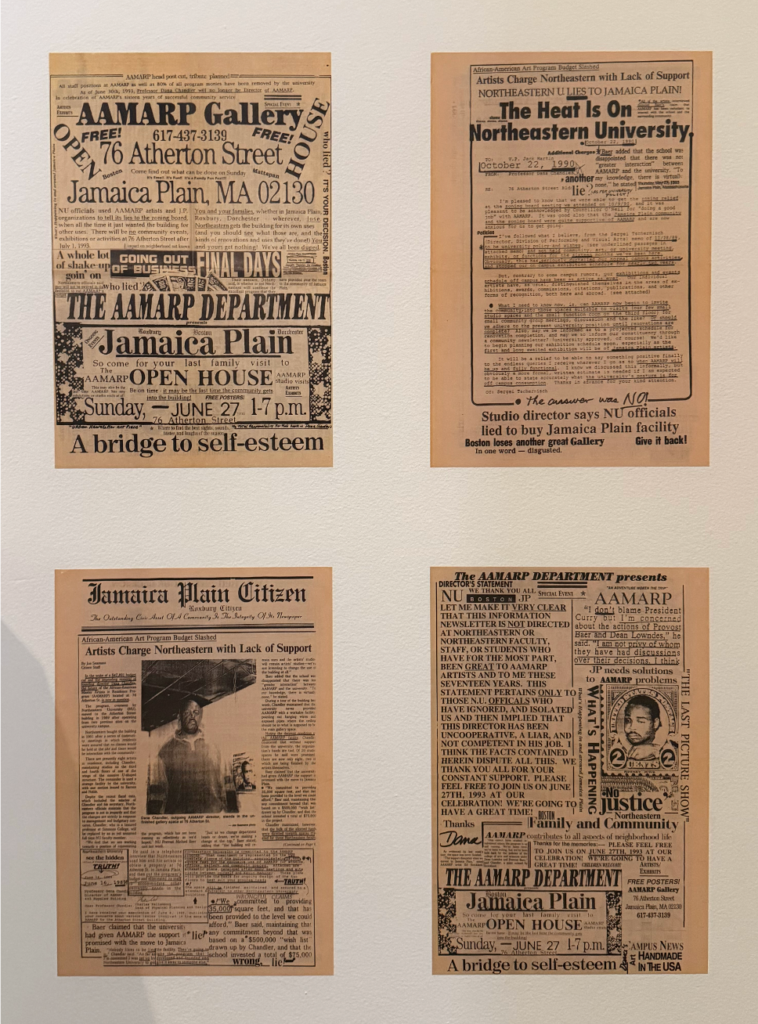
Dana C. Chandler Jr., Urban Newsprint Art Piece, 1993. Newsprint. Installation view, SAY IT LOUD: AAMARP, Institute of Contemporary Art, Boston, 2026. Photo: Leah Wirley.
What does the exhibition catalog allow you to do that the exhibition itself cannot?
De Blois: The catalog operates in a different register. It allows for a depth and a kind of discursiveness that is difficult to achieve in the exhibition space.
In the gallery, you’re working spatially—you’re thinking about how people move through the space, how works relate to each other visually, how the installation unfolds. There are limits to how much text or context you can provide without overwhelming that experience.
The book allows for something else. It allows for chronology, for extended essays, for archival material to be presented in a more sustained way. It allows for multiple voices to enter the conversation. There were things that I knew from the beginning would not be possible to fully realize in the exhibition—certain kinds of historical framing, certain kinds of analysis. The catalog became the place where that could happen.
It also has a different temporal life. The exhibition is time-bound—it exists for a certain duration. The book continues to circulate. It becomes a record, but also a point of entry for future work. And I think that’s important. Ideally, the catalog is not the final word, but part of an ongoing process of interpretation and re-interpretation.
How did you try to preserve the original spirit of AAMARP in the way the exhibition is installed or narrated?
De Blois: One of the most important things for me was to include artists’ voices wherever possible. I didn’t want the exhibition to be framed solely through an institutional voice or a curatorial voice. The artists needed to be present in the narrative.
That creates a kind of polyvocality—multiple perspectives existing alongside each other. And that felt true to the program itself, which was never singular in its orientation.
At the same time, I wanted to be honest about the limits of the archive. Rather than presenting a seamless or totalizing narrative, the exhibition acknowledges gaps, absences, uncertainties.
In terms of installation, the density of the show was a key decision. It’s tightly hung, there are many works in close proximity. That reflects the diversity of the program, but also its energy.
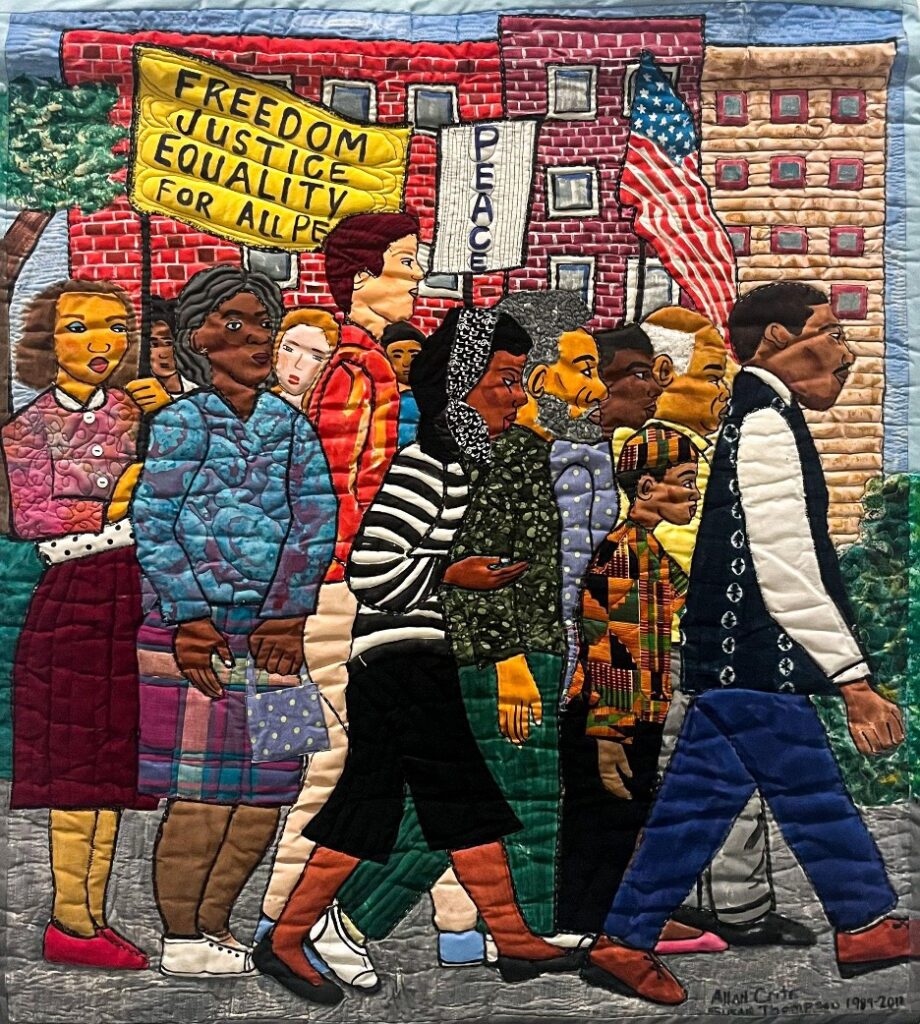
Allan Rohan Crite and Susan Thompson, Freedom, Justice, Equality, 1989–2012. Fabric collage, applique, and painted quilt. Installation view. SAY IT LOUD: AMMARP 1977 TO NOW, Institute of Contemporary Art, Boston. Photo: Thalia Rebello
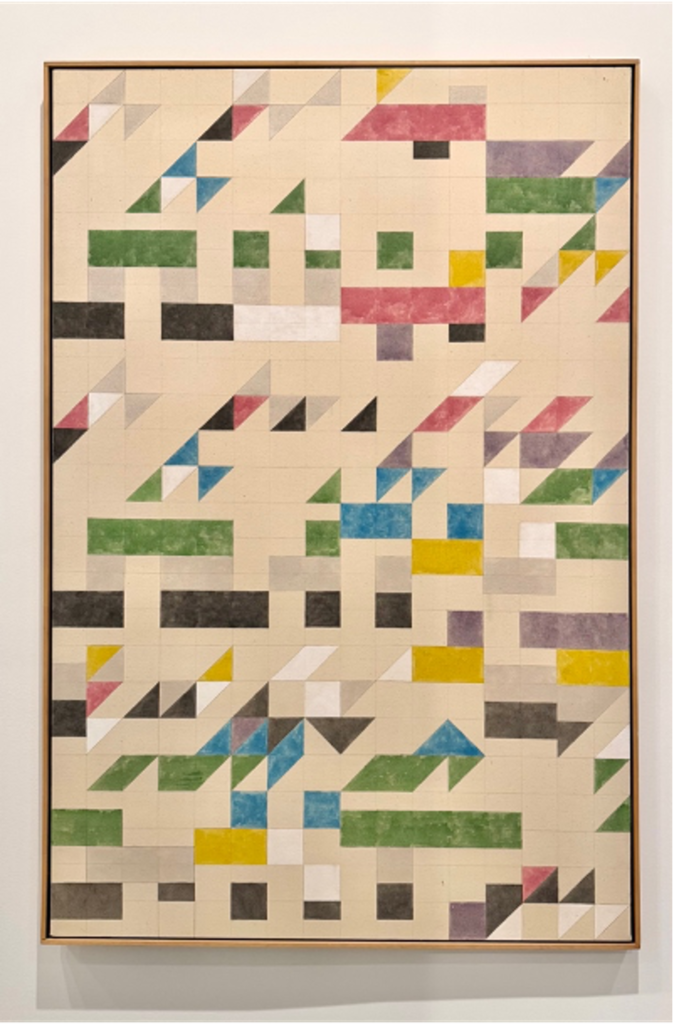
Ellen Banks, Scott Joplin, 1982. Acrylic on canvas. Photo: Say It Loud: AAMARP, 1977 to Now. Photo: Lara Taylor
There’s also an archive room within the exhibition that functions almost as a hinge. It brings together newsletters, documents, ephemera—what I sometimes think of as “receipts.” It shows the program not just as an abstract idea, but as something that was built, sustained, contested.
And then there are more subtle decisions—how works are placed in relation to each other. In some cases, those decisions are based on conversations with artists. For example, placing works by artists who had studios across from each other, who influenced each other’s practice.
Those relationships aren’t always explicitly stated, but they’re embedded in the installation. They create a kind of underlying structure that may not be immediately visible but is nonetheless important.
Finally, is there something about the exhibition that the audiences may not immediately recognize, but that was important to you as a curator? And what conversations do you hope this exhibition continues to generate?
De Blois: I’ve tried to encourage artists and members of the collective to take advantage of that—to initiate their own conversations, to think about how to build something sustainable going forward.
One of the most meaningful aspects of the exhibition has been the reconnection of artists. People who haven’t seen each other in years encountering each other again, remembering works, sharing stories. That’s been incredibly powerful.
Every time someone comes through the exhibition, there’s a new story. Someone recognizes a work, or remembers a moment, or makes a connection that hadn’t been articulated before.
That intergenerational aspect is really important. There are younger artists encountering this history for the first time, and older artists seeing their work reframed in a new context.
Ultimately, I don’t see this exhibition as a definitive account. It’s not meant to be comprehensive, and it’s certainly not meant to be the final word. It’s a starting point. It’s an invitation for others to continue the work—to expand the history, to complicate it, to build on it in ways that I couldn’t. And ideally, ten or twenty years from now, this will just be one version among many. That would be the best outcome.