
Contributing authors Sage Antonio, Quinn Chen Phang, Ryan Coffey, Josephina Green, Soojin (Lucy) Lee, Hoa Hong Ly, Sasha Marmur, Naseem Mohideen, Hyerin Park, Thalia Rebello, Svetlana Russell, Isabelle Song, Lara Taylor, Julia Vazquez, Andrew Wallace, and Leah Wirley are students at Northeastern University.
VoCA is pleased to present this blog post in conjunction with Associate Professor of Contemporary Art History Gloria Sutton’s Spring 2026 course Edit, Filter, Curate: Cultural Production in the Digital Sphere. The seminar explores how cultural production operates within the public sphere through practices of editing, curating, and online dissemination.
Students in Sutton’s course conducted the following interview with Jeffrey De Blois, Mannion Family Curator at the Institute of Contemporary Art Boston, whose exhibition Say It Loud: AAMARP, 1977 to Now (February 12–August 2, 2026) offers a sustained engagement with the African American Master Artists-in-Residence Program (AAMARP). Founded in 1977 by artist, educator, and activist Dana C. Chandler Jr. (1941-2025), AAMARP is one of the longest-running residency programs for Black artists in the United States.
Emerging at the intersection of the Black Arts Movement and the urban transformations reshaping Boston in the late twentieth century, AAMARP was both enabled by and positioned against the institutional frameworks that surrounded it. Housed at Northeastern University—an institution undergoing rapid expansion into historically Black and working-class neighborhoods—the program occupied a complex role: at once supported by university resources and operating as a site of Black self-determination, collective production, and cultural infrastructure that exceeded the university’s own terms.
In this sense, AAMARP can be understood not simply as a residency program, but as a counter-institution: a space that produced its own networks of visibility, critique, and artistic exchange, often in tension with the very structures that made its existence possible. The exhibition Say It Loud and the conversation that follows take up this tension directly, asking how such a history is rendered within a contemporary museum context, and what forms of stewardship, accountability, and narration are required to do so without collapsing its contradictions.
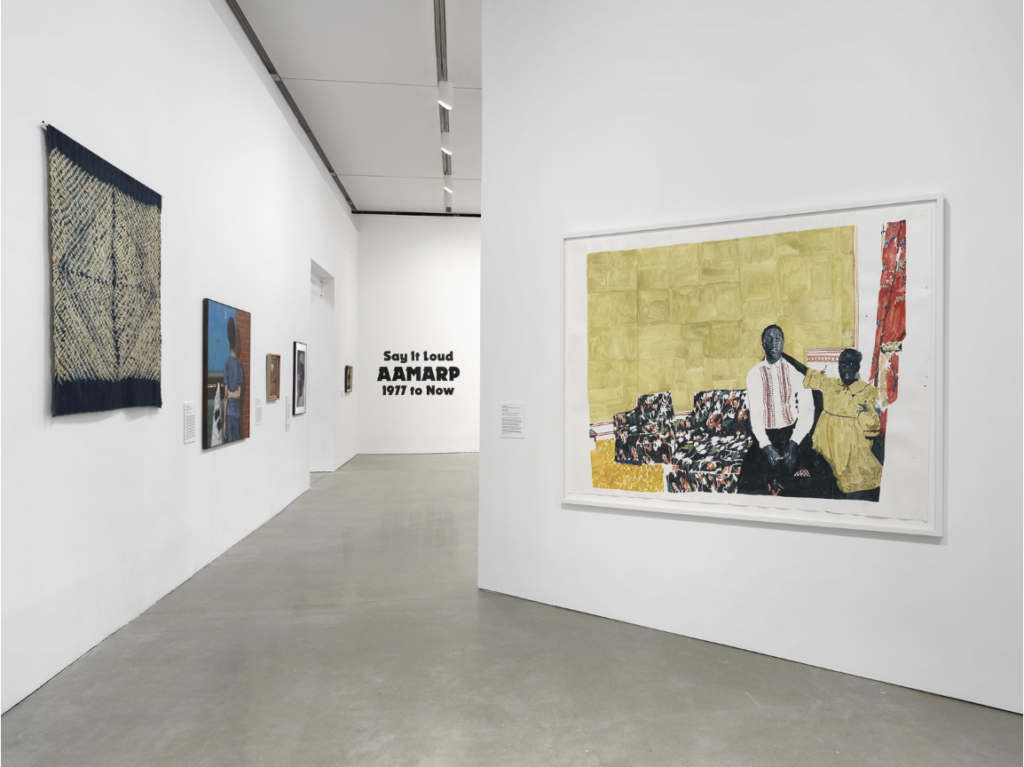
Installation view, Various artworks. Photo: Say It Loud: AAMARP, 1977 To Now, Photo: Dario Lasagni.
As you began researching AAMARP, was there anything you found particularly surprising, and what did you find most compelling about the artists and the story of the program?
De Blois: I think the first real moment of surprise was simply being there—visiting AAMARP for the first time. It’s one thing to encounter a program through archival material or through secondary accounts, but it’s something else entirely to walk into a space and see the work still present, still active in some way. Seeing paintings from the seventies hanging on the walls, not as relics but as part of an ongoing environment, was honestly kind of overwhelming. It immediately complicated any sense that this was a closed chapter.
Then, as I began to work more deeply in Northeastern’s archives, that sense of scale just kept expanding. I realized pretty quickly that what I had initially thought of as a relatively contained residency program was actually something much larger—hundreds of artists, decades of exhibitions, newsletters, ephemera, an entire infrastructure of cultural production that had been built and sustained over time. It wasn’t just a program; it was a network, a community, a set of overlapping histories.
At the same time, one of the most difficult realizations was how much of that work no longer exists. I would find documentation of works in the archive—photographs, references in exhibition checklists—and then learn that those works had been destroyed or stolen. Dana Chandler said to me at one point that he had more works stolen or destroyed than he ever showed. That’s something I keep returning to because it fundamentally shapes how you understand what remains.
It shifts the exhibition from being simply about presentation to something closer to reconstruction—or even investigation. At times, working on the show felt like working on a kind of cold case file. Meghan Clare Considine, curatorial assistant at the ICA and I would be in a room with no windows, pulling together fragments, connecting references, trying to understand how things fit together. There’s a kind of detective work involved when the archive is incomplete in that way.
From the beginning, I understood that the exhibition could only ever be partial. Not just incomplete in a general sense, but structured by absence. There are entire bodies of work that we cannot recover, and that has to be acknowledged rather than smoothed over.
At the same time, what remains is extraordinary. Each artist in the exhibition could sustain a show of this scale on their own. That was something that became very clear very quickly. So the exhibition is also about scale in another sense—it’s about suggesting the magnitude of what existed, even if it can’t be fully represented. And I think that’s part of what I found most compelling: the sense that this was a major cultural moment in Boston, a Black art renaissance, that hasn’t been fully written into art history.
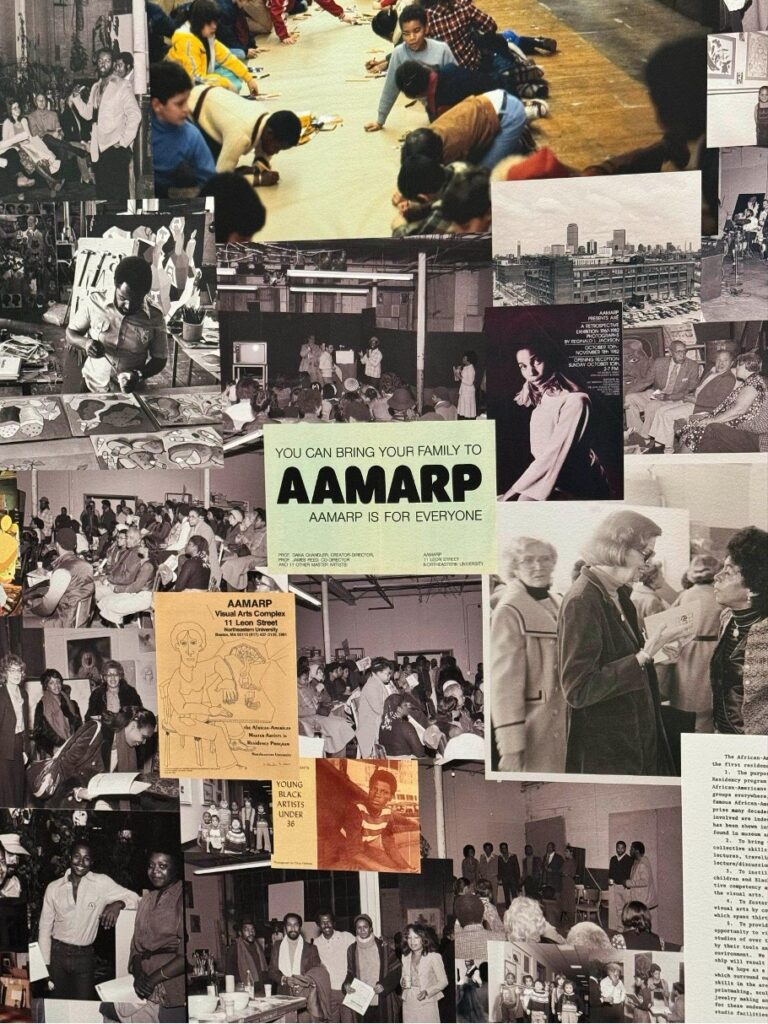
Angela Torchio, Ephemera wallpaper, Northeastern University Archives and Special Collections, date not listed. Printed collage and posters. Installation view, SAY IT LOUD: AAMARP, Institute of Contemporary Art, Boston, 2026. Photo: Svetlana Russell
Do you think institutional recognition amplifies the political force of AAMARP, or risks neutralizing its original radical content?
De Blois: I think I approached the exhibition very much as an act of amplification. That was really the starting point for me—how do we make this history and this ongoing legacy more visible, more legible, in a way that supports its continuation?
Dana said something to me early on that really stuck: “I don’t think Northeastern ever knew what they had with us.” And that became a kind of conceptual anchor for me. The title Say It Loud grows out of that—it’s about volume, but also about insistence, about making something resonate in a way that can’t be ignored.
But I also think the question of radicality is much more complicated than a simple opposition between inside and outside the institution. AAMARP is deeply entangled with Northeastern’s history, and that includes its expansion into Black and brown neighborhoods in Boston. That context is unavoidable. There are artists who have been very direct in saying that AAMARP functioned, at times, as a way for the university to present itself in a certain way to the surrounding community. That’s a critique that needs to be taken seriously. It’s part of the history of the program.
At the same time, the radicality of AAMARP doesn’t originate in the institution. It comes from the Black Arts Movement, from this idea of self-determination, of building your own structures rather than waiting for access to existing ones. That’s where the real force of the program lies.
So even when AAMARP enters a museum context, that doesn’t erase its origins as a counter-institution. If anything, it makes that tension more visible. It raises the question of how that history is framed, who is framing it, and what gets emphasized.
Dana’s own relationship to institutions like the MFA or ICA reflects that complexity. He wasn’t simply rejecting them. He wrote that letter to the MFA in 1970 criticizing institutional racism because he believed the institution could do better. He grew up going there. There was a sense of investment, even as there was critique.
So I don’t think institutional recognition necessarily neutralizes radicality. But it does change the conditions under which that radicality is encountered and interpreted.
AAMARP began in 1977 as an alternative to major institutions at a time when Black artists struggled for visibility. When a program like this enters a museum context decades later, what changes?
De Blois: I think one of the first things that changes is the frame of the question itself. There’s often an assumption that programs like AAMARP existed in a kind of condition of invisibility prior to entering the museum, and I don’t think that’s quite right. There was, and still is, a critical infrastructure for Black art in Boston that exists outside of institutions like the ICA. Artists were showing their work, building audiences, participating in communities. That visibility just didn’t necessarily register within the dominant institutional frameworks.
I remember asking one of the artists in the exhibition, Susan Thompson, whether she felt frustrated that the ICA or MFA weren’t doing studio visits or showing her work. And she said very clearly that she didn’t care. She was focused on making her work and there were other institutions where she was regularly showing her work. That really shifted my thinking. It made me realize that institutional visibility is not the only measure of value or impact.
What the museum context offers is something different. It offers a certain kind of consolidation, a bringing-together of histories that might otherwise remain distributed. It allows for a kind of synthesis.
For this exhibition, I leaned into what I’ve called “curatorial greed.” I wanted to include as many artists as possible—not in a superficial way, but in a way that reflected the density and energy of the program. The installation is intentionally packed. That decision came directly out of looking at installation images from AAMARP exhibitions. There was a kind of visual and spatial density that felt important to preserve—not literally, but conceptually.
At the same time, I was very aware that this exhibition is part of a longer institutional trajectory. There have been exhibitions at the ICA and elsewhere that have helped create the conditions for this kind of project. But Boston’s history, in terms of Black art and institutional recognition, hasn’t been mapped in the same way as other cities. And so part of the work here was to begin to address that.
As a white curator working with a history rooted in Black resistance and community-based artistic networks, how did you think about your positionality and responsibilities in shaping this exhibition?
De Blois: I think the first thing was to not assume anything. I didn’t want to assume that this was a project that people would want, or that it was something that I should automatically be doing.
So before the exhibition was even scheduled, I made a point of talking to as many people as I could—Dana Chandler, the AAMARP executive committee, artists associated with the program. I wanted to understand whether there was support for the project and what people’s concerns might be. Dana’s response—telling me to hurry up and do it—was obviously encouraging, but it also carried a kind of weight. It meant that there was an expectation, that this was something that needed to be done, but also that it needed to be done carefully. From there, the work became about building trust. And I don’t think that’s something that can be taken for granted. It’s something that has to be continually earned.
That meant being transparent about what I was doing, asking questions rather than making assumptions, being open to feedback and criticism. It also meant recognizing that my position as a curator comes with certain forms of authority, whether I want it to or not, and thinking about how to use that responsibly.
I don’t think of curating as a top-down process. I’m not interested in imposing a narrative. My approach is more about trying to understand what’s already there—what the work is doing, what the histories are, what the relationships are—and then finding a way to bring that into a format that can be shared.
At the same time, I’m aware that my perspective is just one among many. There are countless ways this exhibition could have been made. This is one version, shaped by my training, my research, my relationships, but also by the input of many others.
Earning people’s trust is one thing, but what are specific curatorial strategies or collaborations that helped guide those decisions?
De Blois: I think over time you develop a way of working that becomes intuitive, even if it’s not always easy to articulate. For me, it’s about depth—about spending as much time as possible with the material, with the artists, with the histories that are embedded in the work.
With a project like this, where you’re dealing with multiple decades, one of the primary challenges is how to create a sense of cohesion without flattening difference. You don’t want everything to collapse into a single narrative, but you also need some kind of structure that allows people to move through the exhibition in a meaningful way.
So a lot of the work was about identifying relationships—formal relationships between works, conceptual affinities, but also relationships between artists themselves. There are moments in the exhibition where works are placed in proximity because the artists had studios across the hall from each other, or because they were in dialogue in a particular moment. Those aren’t always things that are spelled out in the wall text, but they structure the space.
Research was obviously central. There was a moment where I was talking to Dana Chandler almost every day—fact-checking, clarifying timelines, trying to make sure I was understanding things correctly. And at the same time, working through the archives, looking at newsletters, photographs, ephemera, trying to piece together how the program functioned at different moments.
But I would say that the research and the relationships are inseparable. The conversations with artists were not just supplementary—they were part of how the exhibition took shape. They informed decisions about what to include, how to install it, how to frame it.
There’s also a kind of emotional or affective dimension to the process. I tend to go very deep into projects—I think really hard about what a show is, what it’s trying to do, how it holds together. That’s not always the most efficient way of working, but it’s the way I know how to work.
And in a project like this, where there’s so much at stake, that kind of depth felt necessary.
Part 2 of this interview coming soon; stay tuned!