This week’s returning author, Marshall Reese, is an artist working in new technologies, video, installations, artists books and limited editions. He has worked in collaboration with Nora Ligorano as LigoranoReese for over two decades.
“A tendency to mistake landmarks in the history of taste for landmarks in the history of art remains a problem today, when certain exhibitions become widely discussed and later remembered not for what’s on display but for the controversies the work inspires.”
Jed Perl, Art for the Age of Chaos, NYRB, May 14, 2026[1]
Perl’s statement from his New York Review of Books essay on the Whitney Biennial and New Museum New Humans exhibition provides a barometer for considering the 61st Venice Biennale, which opened in May 2026.
The Biennale is the oldest international art exhibition in the world. Every 2 years, the Biennale showcases some of the most outstanding contemporary art in all media and forms, painting, sculpture, installation, film, video, sound, and performance art, among others. Since its origins in 1895, the Biennale has become an archetypal model for other international exhibitions like the Bienal de São Paolo, Gwangju Biennale, and Documenta.
In the above-mentioned essay, Perl later highlights an observation from conservative journalist Andrew Breitbart, the founder of Breitbart News, that politics is downstream from culture. If the 61st Biennale showed us anything, it’s the inverse: culture is very much downstream from politics.
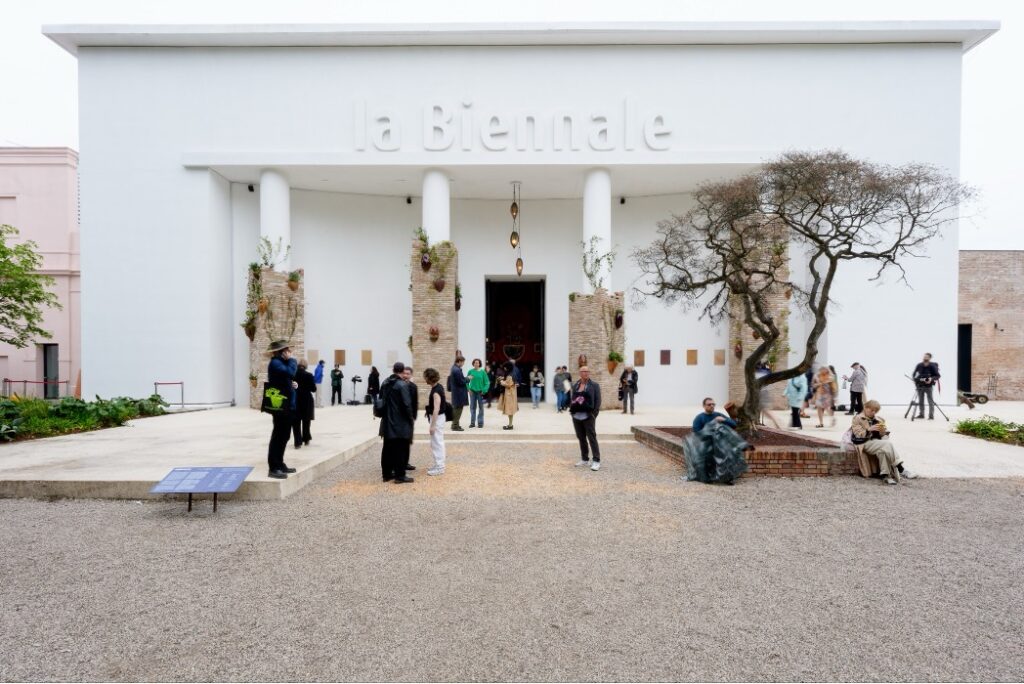
In Minor Keys. Photo by Andrea Avezzu, courtesy of La Biennale di Venezia
The Biennale’s structure and organization, which showcases artists in national pavilions and bestows prizes for artistic excellence, raises questions about the politics of art – who shapes and controls the narrative of what is being seen and how it is being shown. These questions foreshadowed my visit, and were further exacerbated by the death of its curator Koyo Kouoh in May 2025, prior to the Biennale’s opening, and the inclusion of two contested pavilions: Russia and Israel.
In its opening days, the Biennale became the focus for a release of political and cultural energies in response to human rights abuses, sexual repression, the wars in Ukraine and the Middle East. The Giardini, the public park and garden where much of the Biennale takes place, was the center point where the stone was cast and its effects radiated out across Venice in collateral exhibitions and demonstrations around the city.
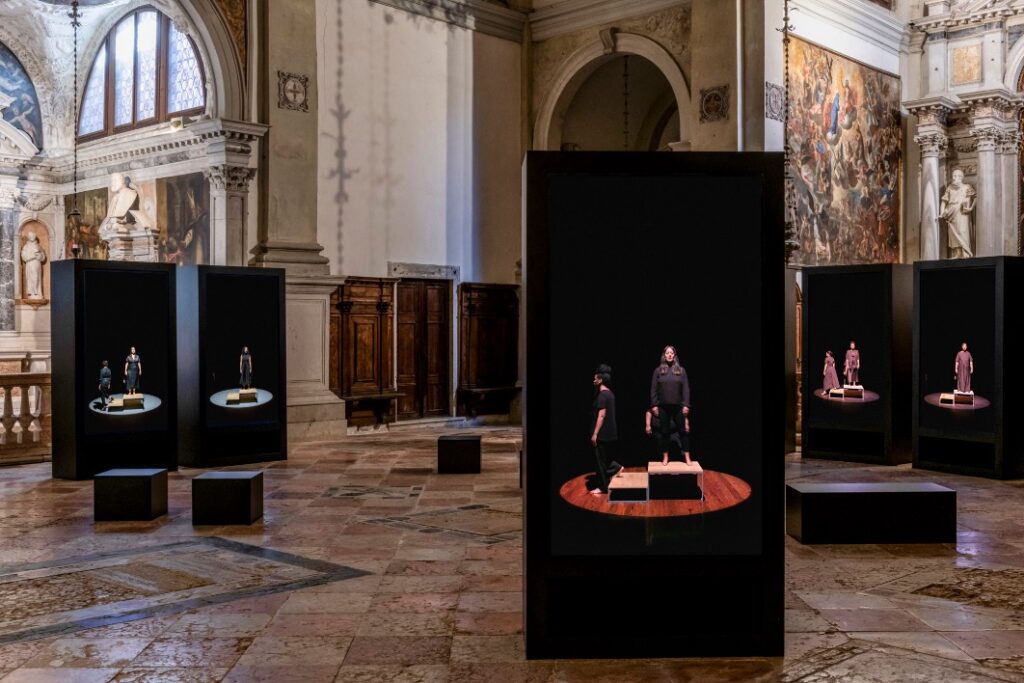
Gabrielle Goliath, Elegy (three suites), 2025-2026, 8-channel video & sound installation, installation view, Chiesa di Sant’Antonin, Venice (2026). Photo by Luca Meneghel, courtesy the artist.
Artist Gabrielle Goliath’s exhibition for the South African pavilion, Elegy – for a poet, was cancelled before the Biennale even opened. The 8-channel video installation, shown instead outside the Biennale in a church, is a hauntingly beautiful work that the artist began in 2025 as a lament about women and LBGTIQ+ people lost to racial and sexual violence. Elegy – for a poet is the third work in a trio of installations (2025-2026) Goliath has made on sexual violence and genocide.
The first Elegy – Ibeleng Christine Moholane centers on the disappearance and murder of Moholane, a 19-year-old journalism student killed in 2014 in Johannesburg. The second Elegy – for two ancestors focuses on 2 women killed by German colonial forces in the Nama and Ovaherero Genocide in Namibia (1904-1908). The third Elegy – for a poet, originally intended for the South African pavilion, debuted in the 12th century Chiesa di Sant’Antonin. The work focuses on the death of Heba Abunada, a Palestinian poet in Gaza. Goliath commissioned poet Maneo Mohale to compose a poem for the installation. Mohale based The Second City on a ghazal, a 7th century Arabic poetic form, drawing on Heba Abunada’s spiritual poem I grant you refuge. 10 days after she wrote her ode, Abunada and her child were killed in an Israeli airstrike in Gaza.
Entering the church’s darkened nave, obsidian-like monoliths, 8 monitors the height of a person, surround the viewer in a semi-circle. On the screens, in a wide shot, Black and brown women in long dark skirts sing sustained notes. A ring of light encircles them. Lit from above, the women sing, each on their own screen as they slowly step out from behind one another, taking their place on a round dais. One singer ends their song as another starts chanting their lament. Together they form a choir whose voices softly resonate throughout the church in collective, mournful unison.
This work was not to have been seen in Venice, however. In December, the South African Minister of Culture Gayton McKenzie cancelled Goliath’s installation.
“…the first threatening letters I started getting in December,” Goliath said to ArtNews, “[the culture minister] very explicitly said that the aspect that deals with femicide in South Africa and the Ovaherero and Nama genocide is acceptable. But you need to remove the aspect that deals with Palestinian life. … For over 10 years, I’ve really been grappling with what is core to the work. And what is core to the work is: Whose lives count? Are they apprehendable as life worth loving, worth grieving after?”[2]
“…one breath
holds us both in its history, as I am held in my father’s hand:
loose enough to lose. on the day of the Flood, in one breathHeba wrote how the gunpowder turned the televisions red
in Gaza, everything changes in an instant. in one breath”Maneo Mohale, The Second City[3]
The South African pavilion remains closed. Yet Goliath’s work is very much open in the Chiesa di Sant’Antonin, with the support of the Bertha Foundation, Ibraaz, ICA Milano, Raffaella Cortese, and the Friends of Elegy.
______
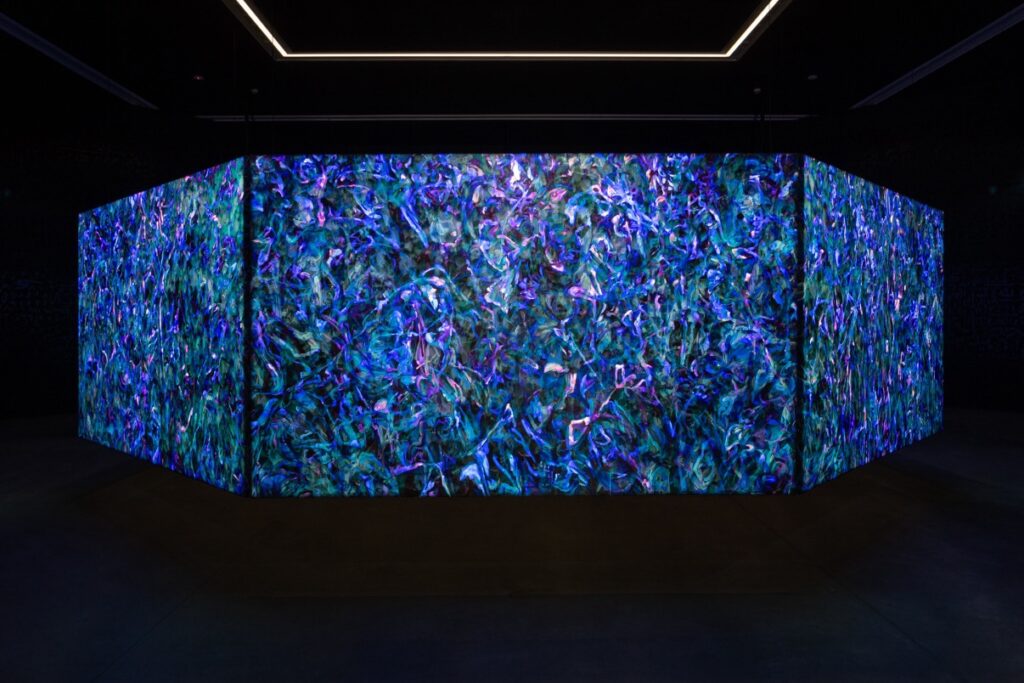
Khaled Sabsabi, conference of one’s self, Eight-channel HD video installation with audio, 8 acrylic paintings on canvas, 2 embroidery textile works, Australian Pavilion, installation view. Photo by Luca Zambelli Bais, courtesy of La Biennale di Venezia
Australian artist Khaled Sabsabi’s conference of one’s self almost suffered the same fate as Goliath. 6 days after his selection to represent Australia in the 61st Biennale, heralded by Creative Australia’s CEO Adrian Collette for work that “reflects the diversity and plurality of Australia’s rich culture, [that] will spark meaningful conversations with audiences around the world,”[4] the commissioning body abruptly rescinded his commission:
“The Board of Creative Australia has made the unanimous decision not to proceed with the artistic team chosen for the Venice Biennale 2026. … the Board believes a prolonged and divisive debate about the 2026 selection outcome poses an unacceptable risk to public support for Australia’s artistic community and could undermine our goal of bringing Australians together through art and creativity.”[5]
It was in reaction to conservative Senator Claire Chandler’s (Tasmania, Liberal Party) demand in Parliament to know why, “with such appalling antisemitism in our country … the Albanese government [is] allowing the person who highlights a terrorist leader in his artwork to represent Australia on the international stage?”[6]
Chandler was referring to Sabsabi’s earlier installation You (2007) featuring a recording of Shia cleric Hassan Nasrallah (Hezbollah’s third secretary general) and another work, a short video appropriated from George W. Bush’s 9/11 speech called Thank You Very Much (2006).
The arts community’s outcry was swift. The same night Creative Australia canceled their commission, Australia’s Ambassador to the Biennale, Simon Mordant, resigned. Cultural institution directors from across Australia deplored the board’s decision. The other artist teams shortlisted for the Australian pavilion issued a joint statement on social media condemning the act, urging Sabsabi to be reinstated. These actions, along with others, forced Creative Australia to conduct an external review that resulted in the recommissioning of Sabsabi’s work.
Sabsabi then earned the added distinction of being both the first Australian artist of Lebanese descent and the first Australian artist representing the country in the national pavilion and the Biennale’s main exhibition at the same time. His two installations share themes he has long explored from his experience as a refugee and his spiritual engagement derived from the practice of Sufism.
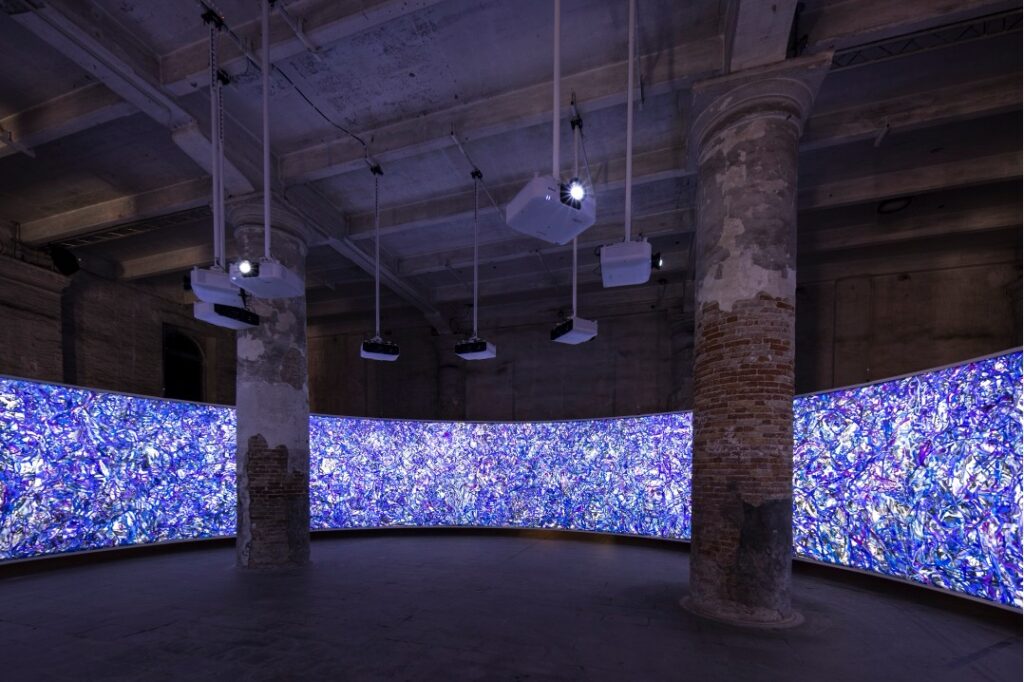
Khaled Sabsabi, khalil, Eight-channel HD video installation with audio, acrylic paint on canvas, steel, black oud scent, In Minor Keys. Photo by Marco Zorzanello, courtesy of La Biennale di Venezia
khalil and conference of one’s self are immersive works, inviting viewers to step into them to wander along circuitous paths. In khalil, located in the Arsenale, viewers walk along an undulating serpentine form consisting of three dimensional, painted canvases 40 meters long that serve as projection screens. In both works the projections slowly undulate, animating the canvas’ surfaces weaving crystalline forms evocative of dancing figures and numbered shapes.
In conference of one’s self the canvases form an octagon which seems to float in the exhibition space’s center. Viewers enter the gallery through entrances that can be either entry ways or exits; viewing the work is an open process to be seen clockwise or counter clockwise. For the artist, the octagon’s eight elements signify completeness and the elevated self. They are the invitation, the threshold, the eight, the reverberation, the script, the commitment, the companion and one’s self.
“I see the eighth level as a symbolic stage of transformation, bringing the audience closer to their truths, where questions become more valuable than answers. Truth isn’t something you find; it is something you become ready to see.”[7]
Khaled Sabsabi
______
Emerging from Gabrielle Goliath’s and Khaled Sabsabi’s installations, one moves from darkness into light, experiencing beauty and emotional depth with a renewed sense of humanity and empathy.
Not all pavilions engage the viewer to that extent. Some are clever and funny like Maja Malou Lyse’s Things to Come at the Danish pavilion imagining a high-tech sperm bank. Some are bizarre like Ei Arakawa-Nash’s Grass Babies, Moon Babies. Both Lyse’s and Arakawa-Nash’s installations nonetheless acknowledge the myriad of problems facing society by offhandedly provoking existential questions about humanity’s very survival.
The American pavilion, on the other hand, represents a more formal aesthetic of hardened forms, shiny surfaces and bright lights. Artist Alma Allen expresses his underlying style sparingly. “I work with my hands over and over and over again until I find the thing that I’m making in the thing.”[8]
Yet more is happening in the American pavilion than meets the eye.
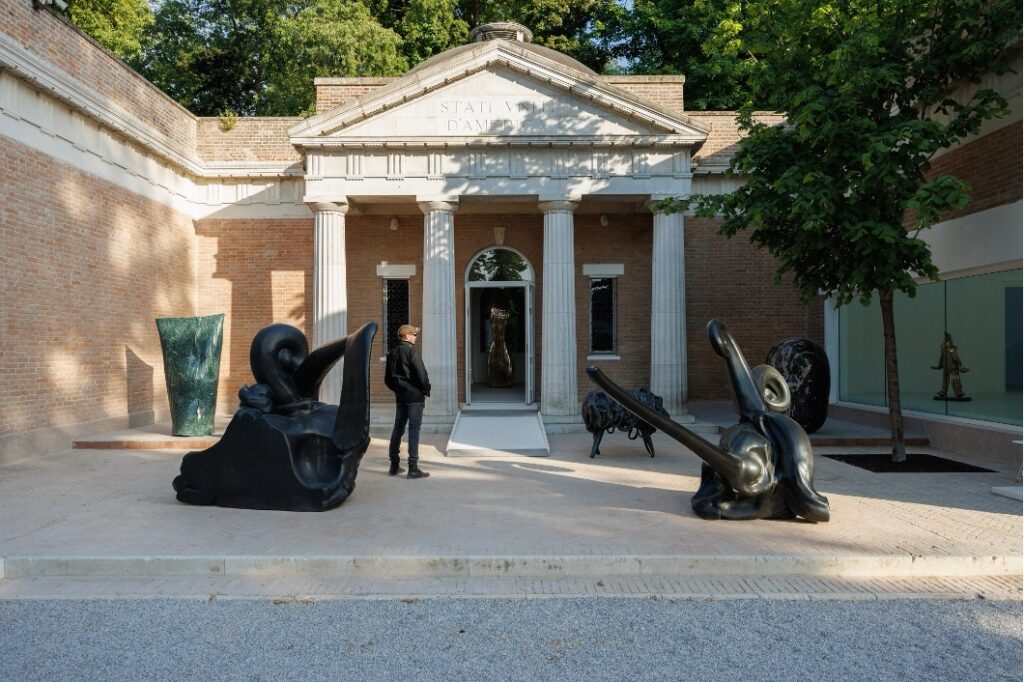
Alma Allen, Call Me The Breeze, U.S. Pavilion. Photo by Jacopo Salvi, courtesy of La Biennale di Venezia
Many protocols governing the American pavilion were eschewed this year. The government shutdown last fall delayed the usual nominating process. Allen’s selection actually sidestepped review by The National Endowment for the Arts and the State Department, who normally weigh in on proposals of artists and exhibitions submitted by museums and non-profits. In the rush to find an American artist in time for the Biennale this year, the State Department preselected Allen.
But it also wouldn’t be unsurprising if Mexico had selected the same artist; since 2017, Allen has resided in Mexico City and has his studio in Topotzlan.[9]
When funders like The Ford Foundation and Andrew W. Mellon Foundation chose to forgo supporting the American pavilion, The American Arts Conservancy, a little-known non-profit based in Tampa, Florida under the direction of former pet store owner Jenni Parido, seized the moment as “a once-in-a-generation opportunity to restore America’s artistic presence abroad while realigning its foundations at home.”[10] The Conservancy in turn sought support through a range of conservative networks.
Ms. Parido luckily had connections, having befriended Erin Scavino at a Mar-A-Lago dog charity event. Scavino, a former Apprentice TV show contestant, is the Art in Embassies Program Director and married to deputy White House chief of staff Dan Scovino.
In what is becoming more and more this administration’s modus operandi – i.e. the “renovations” of the Reflecting Pool, the White House East Wing, and the Kennedy Center, among others – Scavino allowed Parido to privately fund the pavilion. Such actions usually violate the rules and regulations governing American participation in the Biennale.[11] It was this very reason in fact that the State Department cited when cancelling artist Robert Lazzarini’s and the University of South Florida’s original proposal for the 61st Biennale.
The only text in Alma’s exhibition is a large, highly polished, stainless-steel sign that reflects the viewer as they read the text. I saw my own reflection behind the words as I read the curator’s statement, making me surmise that possibly there was more here than simply a shiny wall text. Perhaps, the sign was signaling something about my own role in this state of things – asking me to go beyond a passive viewer to being a more proactive agent in affecting change.
Stepping outside the U.S. Pavilion, I could see that idea in action. Pussy Riot, FEMEN, and others demonstrated in front of the Russian Pavilion with flares on the Biennale preview’s second day; on the third day, 30 national pavilions closed on strike in support of the Palestinian people.
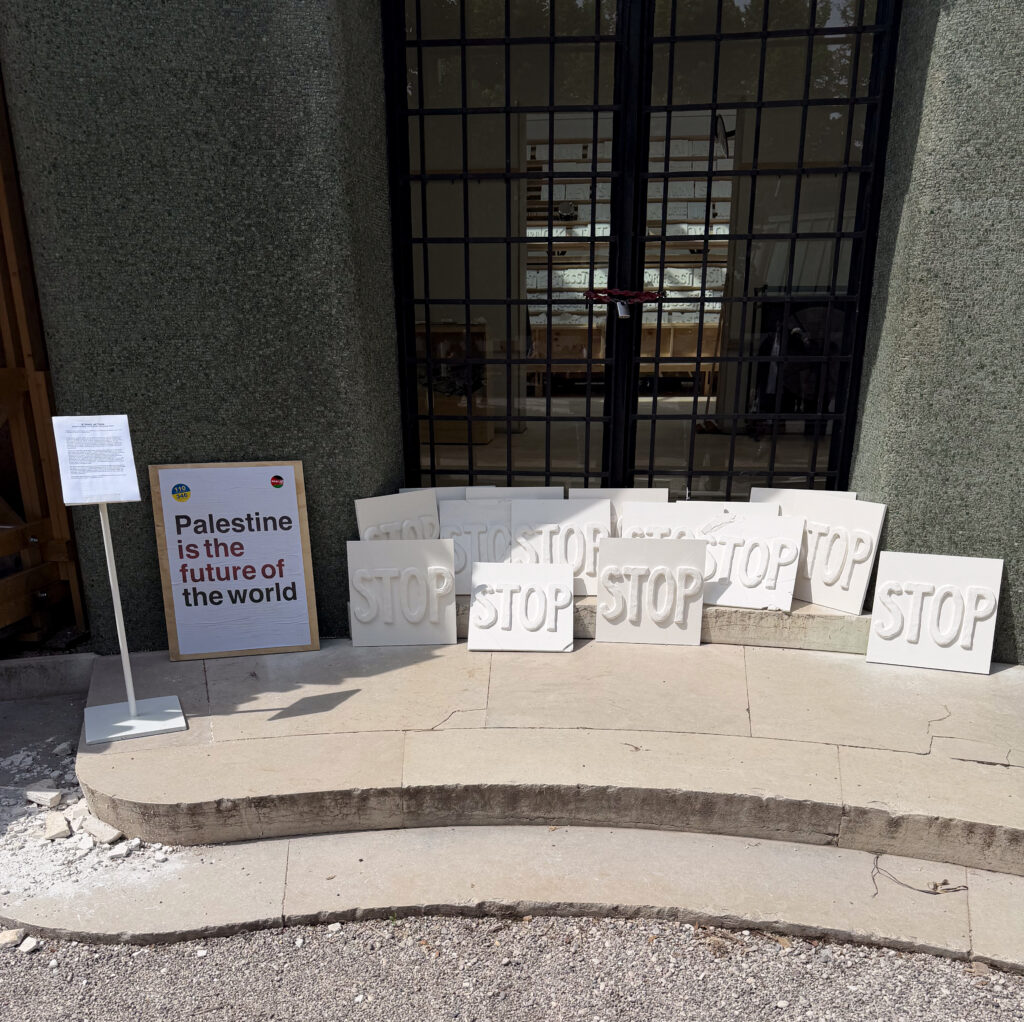
Belgian Pavilion on strike in support of Palestine, May 8, 2026. Photo by Marshall Reese
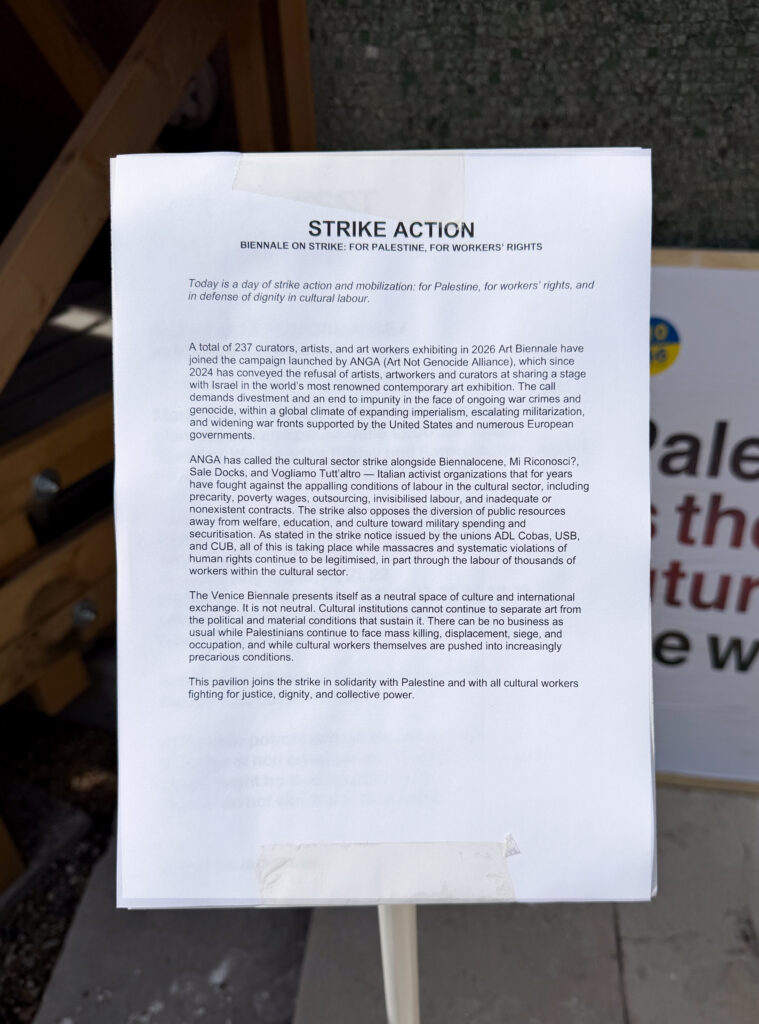
Belgian Pavilion on strike in support of Palestine, May 8, 2026. Photo by Marshall Reese
Art Not Genocide Alliance (ANGA), an international coalition of artists, writers and cultural workers had circulated a petition signed by 240 signatories including 42 artists in the Minor Keys exhibition calling on the Biennale in an open letter to exclude Israel. But it also didn’t stop there: more than 3,500 people demonstrated in front of the Arsenale holding banners saying “No Artwashing Genocide.”
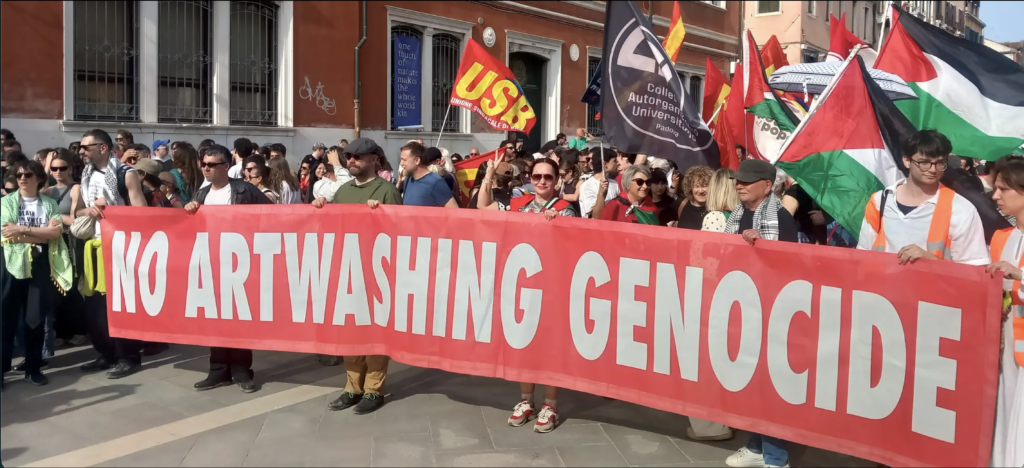
ANGA & art workers on strike. Biennalocene, Vogliamo Tutt’altro, Sale Docks, Mi Riconosci, and Italian trade unions including ADL Cobas, USB, and CUB standing the line. From Eero Yli-Vakkuri, Black, White, Green and Red at Venice Biennale 2026, No NIIN
Photo: Terike Haapoja
As South African artist Nolan Oswald Dennis, whose work is shown in Kouoh’s exhibition In Minor Keys, told Hyperallergic outside the Arsenale, “It’s an artist’s duty to be honest. In this instance, we have to be honest about whom we’re sharing space with: a genocidal state.”[12]
The 61st Biennale’s preview days had become an overture of strident discord commensurate with our time.
[1] Jed Perl, “Art for Our Age of Chaos, New York Review of Books, May 14, 2026, https://www.nybooks.com/articles/2026/05/14/art-for-our-age-of-chaos-new-humans-new-museum-whitney-biennial/
[2] Harrison Jacobs, “Gabrielle Goliath Discusses Her Canceled South African Pavilion as She Shows New Work in a Venice Church,” ARTnews, May 5, 2026, https://www.artnews.com/art-news/artists/gabrielle-goliath-interview-venice-biennale-south-africa-canceled-1234784206/?utm_source=chatgpt.com
[3] “The Second City by Maneo Mohale,” Elegy – The Second City, Gabrielle Goliath, https://www.gabriellegoliath.com/elegy-the-second-city
[4] Creative Australia, “Announcing Australia’s Artist and Curator for the 2026 Venice Biennale,” February 7, 2025, Creative Australia.
[5] Creative Australia, “Venice Biennale 2026,” February 13, 2025, https://creative.gov.au/news-events/news/venice-biennale-2026?utm_source=chatgpt.com
[6] Daniel Browning, “Dumped Artist Khaled Sabsabi Speaks Out about Impact of Creative Australia’s Venice Biennale Decision,” ABC News, April 2, 2025https://www.abc.net.au/news/2025-04-02/khaled-sabsabi-speaks-out-creative-australia-venice-biennale/105118376
[7] Khaled Sabsabi, conference of one’s self, Creative Australia, exhibition brochure.
[8] “US Pavilion to Open at the 61st International Art Exhibition of La Biennale di Venezia With Alma Allen: Call Me the Breeze,” Alma Allen: Call Me the Breeze, https://www.almaallenvenice2026.org/press/rt735teg5igtzkh2egjiy95v0dtteb
[9] Zachary Small, “Alma Allen, American Sculptor, Is Selected for Venice Biennale, New York Times, November 24, 2025,https://www.nytimes.com/2025/11/24/arts/design/alma-allen-venice-biennale.html
[10] “Biennale Arte 2026,” The American Arts Conservancy, https://web.archive.org/web/20260729112939/https://www.theamericanartsconservancy.org/61st-biennale-di-venezia
[11] Zachary Small, “With Trump Novices Can the U.S. Win the Art Olympics,” New York Times, April 19, 2026 https://www.nytimes.com/2026/04/19/arts/design/venice-biennale-trump-us-pavilion.html
[12] Hakim Bishara, “Hundreds Protest Israel’s ‘Genocide Pavilion’ at Venice Biennale,” Hyperallergic, May 6, 2026 https://hyperallergic.com/hundreds-protest-israels-genocide-pavilion-at-venice-biennale