
This week’s contributing author, Leyi Yuan, is an undergraduate student at Northeastern University and a writer based in Boston. Her areas of interest include site-specific installation, material processes, and the role of cultural institutions in shaping public engagement with contemporary art. She previously worked at the Institute of Contemporary Art/Boston in Marketing and Communications.
Man-made Land (2025) is a newly commissioned work by Anishinaabe French and Canadian artist Caroline Monnet,[1] accompanying An Indigenous Present at the ICA Boston (Oct 9, 2025 – Mar 8, 2026), a major group exhibition of contemporary Indigenous art, guest-curated by Jeffrey Gibson and Jenelle Porter.[2] On view from Sep 25, 2025 – Mar 21, 2027 and measuring approximately 48 feet wide by 27 feet tall, the installation occupies nearly the entire east interior wall of the ICA Boston’s glass-walled lobby, engulfing your field of vision upon entrance. Beyond its monumental surface, Man-made Land is shaped by months of studio production and installation logistics, highlighting the challenge of how a museum cares for a large-scale, process-based commission.
Stepping inside the ICA lobby, numerous geometric “blooms” unfold across the wall; circular and semicircular patterns combine and cluster in layered rhythms, shimmering as if mapping a terrain. Standing before the wall, you will see pleated sheets of building materials such as Tyvek, plastic, and foil insulation. They catch and scatter light, as if the wall itself were breathing.
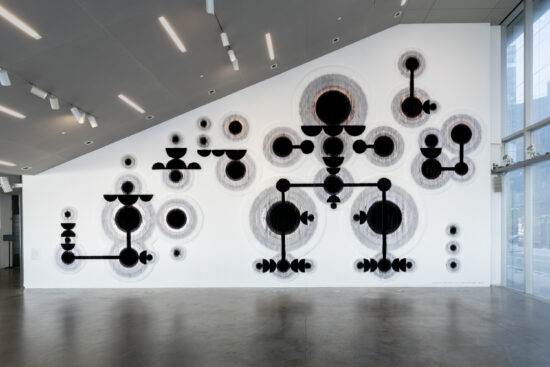
Installation view, Caroline Monnet: Man-made Land, the Institute of Contemporary Art/Boston, 2025-27. Photo by Mel Taing.
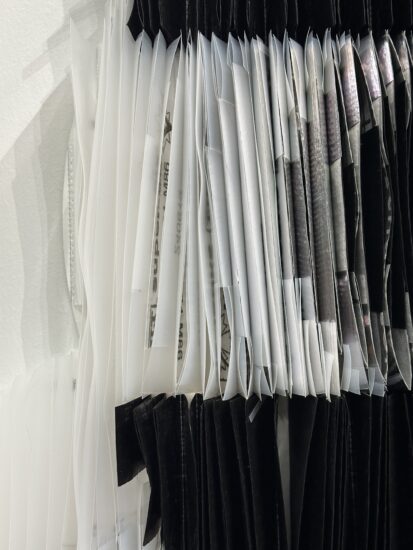
Detail of Caroline Monnet: Man-made Land. Photo by the author.
Man-made Land was built by weaving layered building materials into geometric shapes. As Monnet noted in The Artist’s Voice,[3] she grew up surrounded by building materials because of her family background, which functions as a familiar material language that she reworks through weaving. Monnet abstracts her motifs from Anishinaabe designs found on regalia, birch bark baskets, and beadwork. In Kikinaham-To Sing Along With 01 & 02 (2023), a two-part, modestly scaled wall work (28 x 42¾ inches each), she first adapted traditional basketry techniques by weaving pink roof underlay and black waterproofing membrane. In 2015, her 3-minute short film Mobilize reflected on ancestral participation in contemporary construction. The integration of Indigenous craft, urban modernity, and abstraction has long featured in her practice. In many Anishinaabe craft traditions, technique is inseparable from worldview. Knowledge grows through labor, time, and making process rather than through a final form. Through cross-media practice, Monnet carried forward such cultural knowledge in contemporary materials through indigenous techniques.
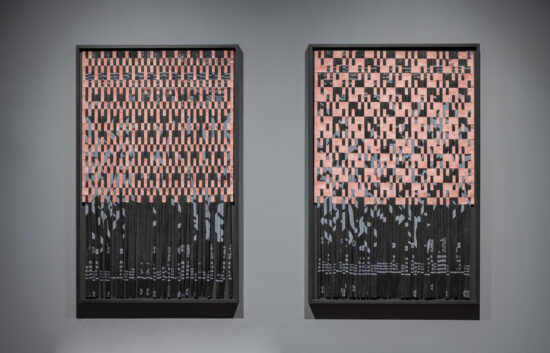
Caroline Monnet, Kikinaham – To Sing Along With 01 & 02, 2023. Weaving, roof underlay, and waterproofing membrane. Two parts, each 28 x 42 3/4 inches (71.1 x 108.6 cm). Courtesy the artist and John Cook. Photo by Toni Hafkenscheid, Art Museum at the University of Toronto. © Caroline Monnet
As a multidisciplinary artist working across painting, film, fashion, and sculpture, often addressing Indigenous identity and modernity through industrial materials, Man-made Land expands Monnet’s practice to its largest scale to date. Over seven months of full-time production, she and two assistants worked together in her studio, sewing and assembling each section. At the Artist’s Voice, Monnet explained that this work is “one of [her] most ambitious projects in terms of the making time and the handwork involved.”[4]
Yet the ambition extends beyond the scale of handmaking. According to Monnet, Boston’s history of reclamation fundamentally conflicts with the Anishinaabe philosophy of “living and belonging to the land, rather than owning as property.”[5] Monnet’s choice of materials for Man-made Land directly responds to the construction language that shaped Boston’s harborfront. In commercial architecture, Tyvek, plastic, and foil insulation function as protective barriers. They wrap buildings to block moisture, control temperature, and seal the structure from outside elements. In Monnet’s artistic practice, industrial materials no longer enforce borders. Instead, they become ways to connect people with culture and knowledge.
Within Man-made Land, the cultural meaning of building materials emerges only through the production that transforms them. These materials place a different demand on the museum to care for the process that shapes the meaning. While Man-made Land required seven months of full-time studio production, it will be on display for less than eighteen months at the ICA. Once inside the museum, the work entered the Art Wall rotation system, where its duration is constrained by fixed display periods.
As the commissioner and exhibitor of Man-made Land, the ICA provided resources and space that made such large-scale work possible. ICA’s Sandra and Gerald Fineberg Art Wall is a site dedicated to original commissioned work that rotates cyclically, inviting artists to produce works specifically for the museum’s lobby architecture. While most commissions remain on view for approximately one year, Man-made Land’s eighteen-month display already marks the longest display period in the program’s history. It is also the only commission to date that directly engages the geography of Boston and the museum’s waterfront location.
However, within the Art Wall’s rotation system, removal is an expected ultimate phase of the commission’s lifecycle. In this sense, the work’s seven months of concentrated studio production contrast with the institutionally determined duration of its display.
In Man-made Land, the industrial materials hold cultural meaning through the processes that shape and transform them. Once dismantled, they no longer occupy the cultural and geographical relations that structured their display. This challenges traditional conservation’s emphasis on preserving finished forms, because process-based knowledge cannot be archived in the same way. If the work’s cultural meaning lives in its activation, the question becomes how institutions might care for what disappears once the work is dismantled.
Monnet’s work concludes when the final seam is stitched; the museum’s stewardship responsibility comes afterward. Preserving process means caring for the artist’s time, methods, and relations that shaped the work, rather than focusing solely on the fixed display outcome. Man-made Land foregrounds how Indigenous knowledge persists through ongoing practice, suggesting that stewardship may extend beyond the preservation of the object alone.
When the work is finally dismantled, what will remain is not only documentation and memory, but also a model of how institutional care might be understood in relation to process-based commissions. The institution’s responsibility is not to replicate the production itself, but to sustain the institutional conditions that frame how such practices are presented, replaced, and remembered, even after the object is gone from view.
[1] Institute of Contemporary Art/Boston, “Caroline Monnet: Man-made Land,” curated by Jeffrey Gibson and Jenelle Porter, September 25, 2025 – January 18, 2027, https://www.icaboston.org/exhibitions/caroline-monnet-man-made-land/.
[2] Institute of Contemporary Art/Boston, “An Indigenous Present,” curated by Jeffrey Gibson and Jenelle Porter, October 9, 2025 – March 8, 2026, https://www.icaboston.org/exhibitions/an-indigenous-present/.
[3] Institute of Contemporary Art/Boston, “The Artist’s Voice: Caroline Monnet and Sky Hopinka with Jenelle Porter,” artist talk, October 23, 2025.
[4] Ibid.
[5] Ibid.