
This week’s contributing author, Giulia Walker, is in her final year as student at Northeastern University earning a BFA in Design in the spring of 2026. She is particularly interested in exploring how the practice of design and design thinking intersects with community engagement, sustainability, and urban spaces.
Those familiar with Boston know the South End as one of the city’s iconic spots. It’s dreamlike in its aesthetic with Victorian style brownstone townhouses along slightly crooked roads with auburn fall leaves. Yet what people often overlook are the significant gentrification and demographic shifts that took place in the 20th century, raising concerns about community and the preservation of neighborhood memory.[1] Artist Allan Crite (1910 – 2007) captured these morphing stages from his own perspective.[2]
Allan Crite was an African American artist raised in Boston’s South End who ultimately stationed his practice there. Best known for his ink and pen drawings, Crite also worked with a range of media such as lithographs, oil painting, and watercolor, often documenting life in the neighborhood and Lower Roxbury. However, Crite was not just an artist; a plaque outside one of his former apartments highlights his legacy as a “visual artist, painter, printmaker, author, lecturer, historian, and good neighbor.”[3] Throughout the twentieth century, his work “serve[d] as a landscape and social history of Black Boston, mapping segregation and urban renewal, Black arts, and the Black Power movement, all of which foregrounded Crite’s critical belief in an inclusive human family.”[4] Across both secular and religious themes, Crite consistently portrayed Black life in the everyday.
The exhibition Allan Rohan Crite: Urban Glory – held at the Isabella Stewart Gardner Museum from October 2025 to January 2026 – honored Crite as a true visual storyteller devoted to preserving community memories of Boston’s historical neighborhoods. Co-curated by Diana Greenwald and Theodore Landsmark, the exhibition focused on the first half of Crite’s career, when he was working with oil painting before transitioning to distributable prints.[5] Yet for all its good intentions, the exhibition felt under developed despite its prestigious setting of the Gardner, presenting institutional structural barriers, from admission costs to gallery design, that distanced Crite’s work from the very communities it was meant to honor. In a 1979 interview, Crite claimed that his work was made for the broadest public, stating, “All my drawings are designed for somebody else, not designed for me… People in general. I just wanted to convey something to people as a whole.”[6] Through representation and storytelling, Crite’s work successfully serves as a record of his community and cultural identity; unfortunately, the Gardner’s presentation skewed the meaning and value of the work, effectively contradicting the art’s emphasis on accessibility, community, and humanity.
One of the clearest contradictions between Crite’s values and the museum’s presentation emerged in the question of accessibility itself. Despite the museum’s registration as a non-profit and its support by major private donors such as the Barr and Mellon Foundations,[7] the standard admission ticket is $22 with only one free Thursday admission each month.[8] So although the museum aimed to honor the community artist, the steep price tag rendered the show largely inaccessible to the very communities Crite depicted.
The gallery’s spatial arrangement and lighting also undermined the intimacy and power of Crite’s art. As an artist who often employed religious motifs to encourage his Black neighbors to recognize and perceive their own humanity as divine, his work can evoke a sense of reverence and worship. Upon entry into the main gallery, paintings containing street scenes were placed on parallel walls across from religious and liturgical works, igniting a conversation between the spiritual, political, and social everyday. Crite’s Streetcar Madonna (1936) exemplifies this fusion “connecting art and cultural narrative with community identification, preservation, and empowerment,” [9] by showing Mary and baby Jesus seated on Boston’s MBTA Green Line. By portraying the Divine in this urban scene, Crite illustrates his belief that the Holy exists in the mundane, paying tribute to his neighbors. Yet the display felt stagnant and absent of the spiritual, the bright lighting and crammed frames failed to create intimacy the work demands resulting in the typical institutional effect of the “white box.” Interestingly enough, this particular space has been transformed to meet the tone of the work on display in the past; a successful example was seen in the exhibition Waters of the Abyss: An Intersection of Spirit and Freedom, displayed in the same gallery just months prior. Scholar Thea Tagle, writing for the Boston Art Review, stated, “the artist has transformed a sterile space, opening a portal to an undersea or island sovereign kingdom,” a transformation Crite’s exhibition did not achieve.[10]
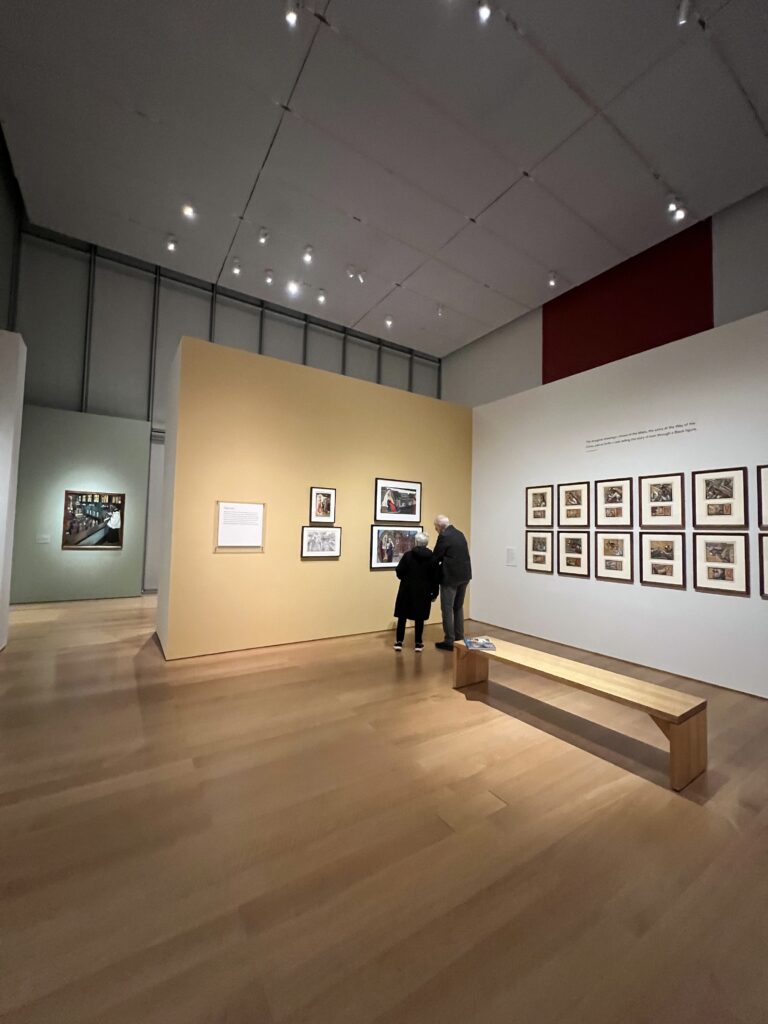
Allan Rohan Crite: Urban Glory (installation view), 2025, Isabella Stewart Gardner Museum. Photo Giulia Walker.
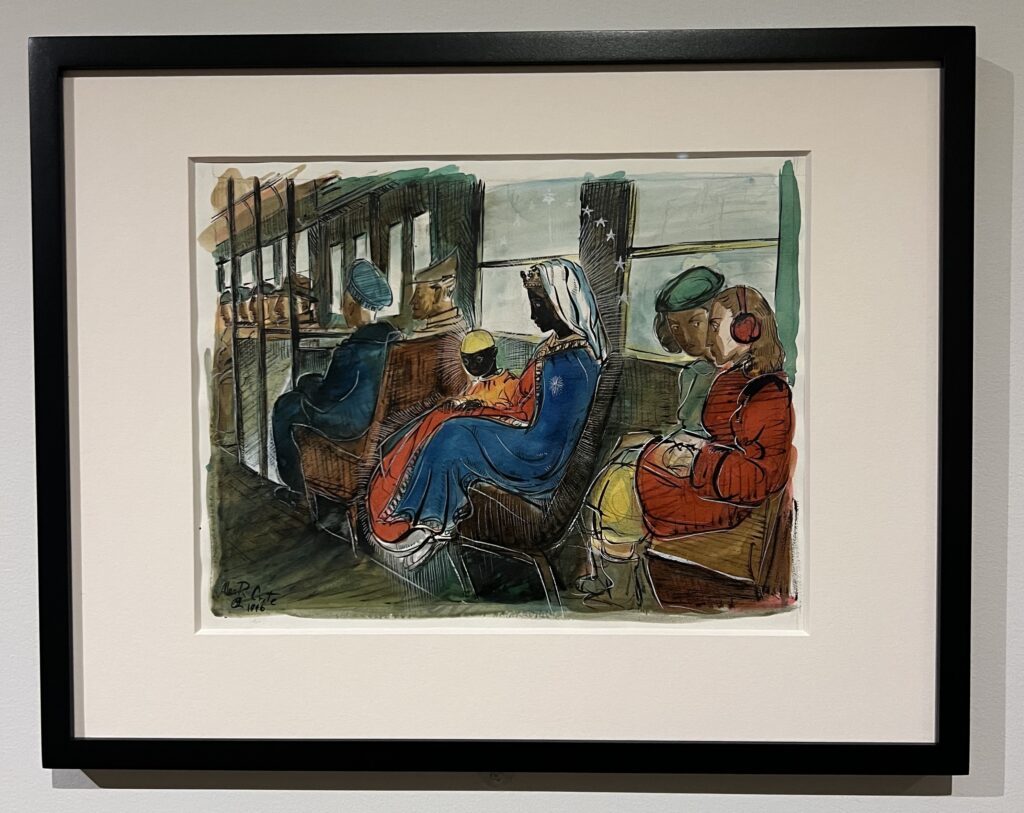
Allan Crite, Streetcar Madonna, 1936, Isabella Stewart Gardner Museum. Photo Giulia Walker.
The disconnect between presentation, Crite’s intentions, and the museum’s choices was also echoed in the kinds of works the institution chose to foreground. Oil paintings seemed to dominate the exhibition, yet Crite abandoned the material early on in his career due to its lack of accessibility.[11] He then pursued print due to its distributable qualities that he could share to the public directly, revealing his values not only in his subject matter but also in choice of material.[12] The entry gallery did display some sketches and written material, but the arrangement suggested the works on paper were simply there as a thoroughfare towards the paintings. While these efforts to democratize material do not go unappreciated, there lacked effective, contextual support and curatorial framing that ultimately allowed for the oil paintings to take center stage. Curator Diana Greenwald acknowledges the larger issue of oil painting commanding exhibitions, which “has all sorts of discriminatory effects because we know that artists of color and women are far more active on works on paper.”[13]
The installation of the “The House,” which provided a glimpse into Crite’s personal space by recreating his apartment walls, ultimately formed the most immersive and community rooted section of the exhibition. Yet, “The House” still felt incomplete and restricted, as though the creative liberty to present an unfiltered, raw, and sometimes erotic artistic vision did not fit in the institutional setting. Historically, Crite experienced censorship in his display of such “erotic” works once at Roxbury Community College in the 1980s and again at the University of Massachusetts, Boston in the 1990s.[14] In Urban Glory, some of Crite’s sketches and prints present as sexual in contrast to the placement alongside religious scenes, such as a watercolor of a man and woman standing naked in front of the window. However, Crite’s true intentions behind the naked body were to express a sense of humanness and intimacy, a meaning lost in this representation.[15] Johnetta Tinker, a mentee and artist of Crite, explains that “He called it human art. This is the human being. This is natural. This is how we’re all conceived, you know? He always talked about Adam and Eve; they were nude.”[16] While some images seem “erotic,” such as one drawing of two naked figures entangled atop one another, the display felt particularly conservative in comparison to the video evidence just steps away. A small TV diagonally across from the installation presents a video of Crite’s work in his house layered floor to ceiling of prints and sketches in a beautiful, chaotic way. Without clarity of Crite’s intentions around humanness and female agency, the display felt misaligned.
Even so, inclusion of such an installation was absolutely critical for this exhibition. Crite’s apartment was home to many, functioning as a hub for civic life: a base for artistic education, an office for the Rainbow Coalition, and the headquarters for the Boston Collective.[17] Due to a highway restructuring plan that was ultimately never completed, Crite and his mother were evicted in 1971 and the house was demolished despite advocacy to preserve it.[18] Through its physical recreation, Crite’s space served to preserve pioneering ideas and relationships that helped shape Crite’s creativity. It allowed viewers to “walk into the culture that he had created,”[19] but deserved to be constructed in a way that conveyed even more of its richness and soul.
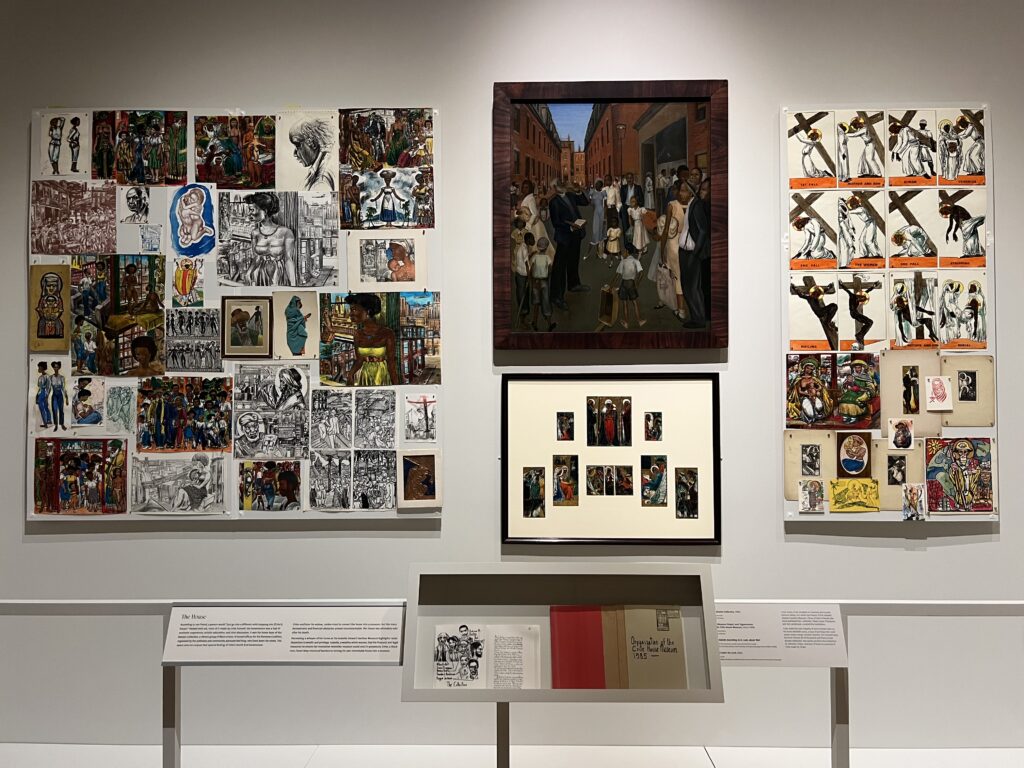
“The House” installation shot, 2025, Isabella Stewart Gardner Museum. Photo Giulia Walker.
Allan Rohan Crite: Urban Glory sought to celebrate Crite’s art and commitment to preserving Black Boston stories, yet institutional barriers limited how fully that legacy could be shared. While honoring a public figure committed to civic presentation, the museum struggled to present his work in a manner that reflects the people, place, and values Crite devoted his life to documenting. How we present art ultimately shapes how we preserve it, influencing how future generations will understand both the art and artist. The exhibition left viewers marveling at Crite’s craft and devotion to visually capturing stories that could have easily faded from memory. What does it mean to preserve community stories inside institutions whose structures still limit access for the communities who made those stories possible? Next time you find yourself strolling around the South End, consider which stories have surfaced and which still struggle to be recognized.
[1] Wall text, Allan Rohan Crite: Urban Glory, Hostetter Gallery, Isabella Stewart Gardner Museum, Boston, MA.
[2] Ibid.
[3] Diana Greenwald and Christina Michelon, eds., Allan Rohan Crite: Neighborhood Liturgy (Princeton University Press, 2025), 125.
[4] Ibid.
[5] Wall text, Allan Rohan Crite: Urban Glory.
[6] Allan Crite, “Oral history interview with Allan Rohan Crite, 1979 January 16-1980 October 22,” interview by Rober Brown, Smithsonian Archives of American Art, 38, https://www.aaa.si.edu/download_pdf_transcript/ajax?record_id=edanmdm-AAADCD_oh_212600.
[7] “Fall 2025 Exhibition,” Isabella Stewart Gardner Museum, accessed February 21, 2026, at https://www.gardnermuseum.org/fall-2025-exhibitions.
[8] “Admissions,” Isabella Stewart Gardner Museum, accessed February 21, 2026, at https://www.gardnermuseum.org/visit/admissions?gad_source=1&gad_campaignid=21067677343&gbraid=0AAAAADiWbRhlbt77DeSMX4aBLvRH1RuuF&gclid=CjwKCAiA0eTJBhBaEiwAPahRxVZn_Mh96YnEe_t2SauZDcLBN5UAjFYbDwdTRQ32zKjbdvoo1fGhoC0McQAvD_BwE.
[9] Greenwald and Michelon, Allan Rohan Crite: Neighborhood Liturgy, 9.
[10] Thea Tagle, “Portals to Power: Fabiola Jean-Louis at the Gardner,” Boston Art Review, April 28, 2025, https://www.bostonartreview.com/read/fabiola-jean-louis-waters-of-the-abyss-isgm-thea-quiray-tagle.
[11] Wall text, Allan Rohan Crite: Urban Glory.
[12] Ibid.
[13] Arielle Gray, “From the divine to the intimate, Allan Rohan Crite’s ‘human art’,” WBUR, October 22, 2025, https://www.wbur.org/news/2025/10/22/allan-rohan-crite-human-art
[14] Ibid.
[15] Ibid.
[16] Ibid.
[17] Wall text, “The House,” Allan Rohan Crite: Urban Glory, Hostetter Gallery, Isabella Stewart Gardner Museum, Boston, MA.
[18] Ibid.
[19] “Video Installation,” Allan Rohan Crite: Urban Glory, Hostetter Gallery, Isabella Stewart Gardner Museum, Boston, MA.