This week’s contributing author, Cassidy Westjohn, is an interdisciplinary artist currently based in Boston, working as the Public Programs Coordinator at the MIT List Visual Arts Center. She received her MFA from the School of the Museum of Fine Arts at Tufts University.
Two Artists Talking is a special limited-edition book of interviews with Boston-area artists conducted by students attending School of the Museum of Fine Arts (SMFA) at Tufts University. The conversations explore meaning, materials, process, and career strategy, and serve as evidence that there are no right answers in how to navigate life and career as an artist. Printed in 2026, Two Artists Talking was designed and edited by artists McCall Hollister, Eva Lundsager, and Cassidy Westjohn. In this article, Westjohn reflects on the experience of creating the book, and how the interviews inspired her and her colleagues to bring the publication to print.
At the time of conducting my interview for Two Artists Talking in spring of 2022, it felt like a valuable opportunity to speak with an artist fresh out of an MFA program. I hoped to get an understanding of what life as an emerging artist might look like. I remember walking away from my interview, startled and wary of what my future could be as someone interested in becoming an educator. I spoke with Brooke Stewart, an artist early in her career, who had recently received her MFA and was teaching as a part-time professor at Northeastern University and SMFA. During our conversation, Brooke went into detail about how stressful it can be applying to opportunities such as teaching positions or exhibitions over and over, facing continual rejection. It felt like a cold dunk of water, shocking to my senses when I would be facing life after graduate school so soon. It was an honest look–something I needed at that time.
Now, three years after graduating with my own MFA, I feel grateful for that chance to converse with someone who had so recently followed a path similar to my own. Our conversation showed me how much I would have to fight to have an art practice and make a living at the same time, but how beneficial having a community can be towards achieving that goal. Brooke said it plainly at the end of her interview: “The only reason we exist is because we help each other.”
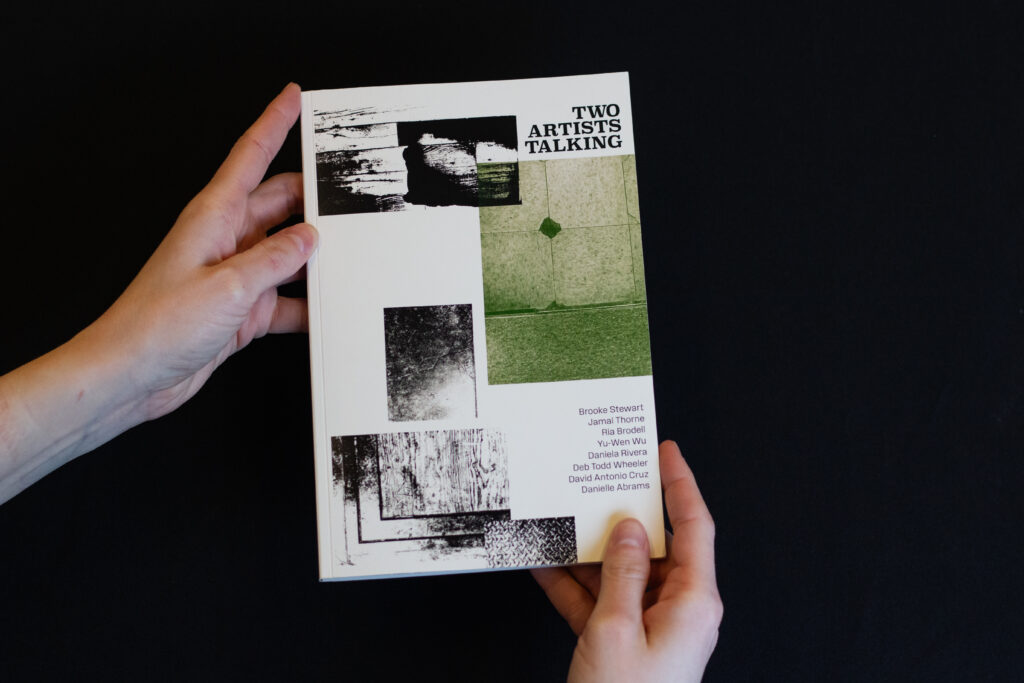
Two Artists Talking, 2026, Photo: Gwyneth Koeckhoven
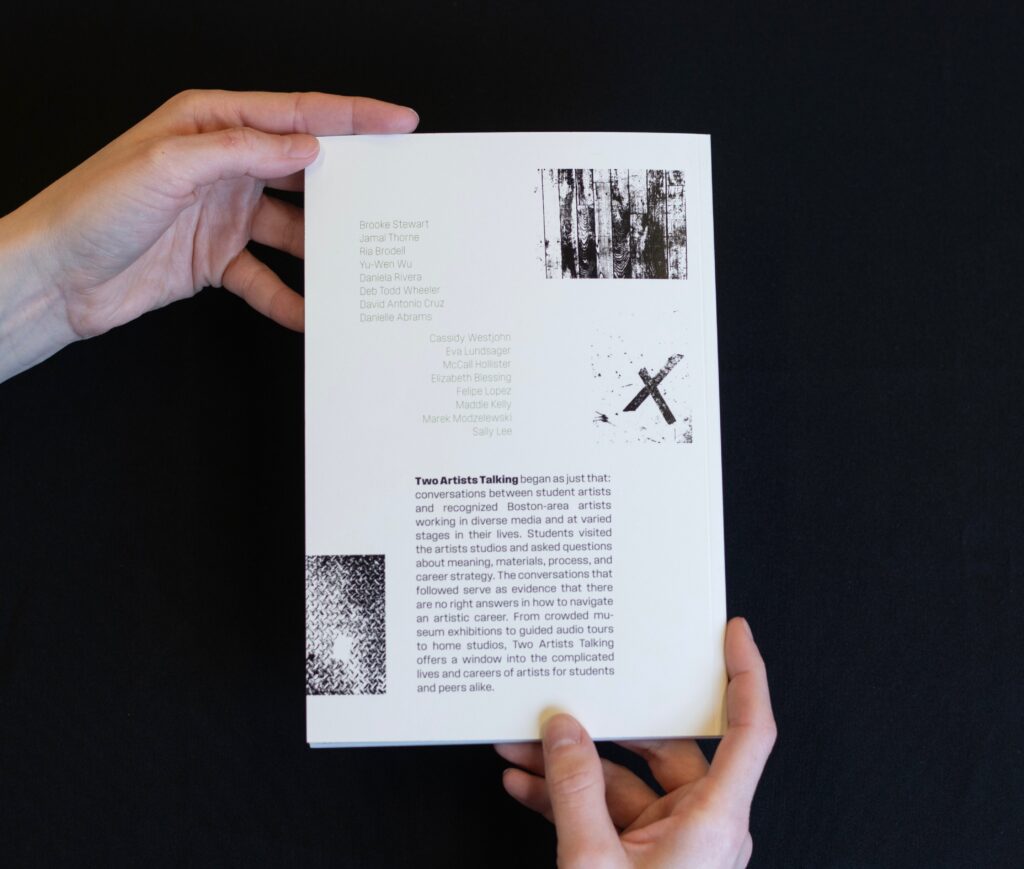
Two Artists Talking, 2026, Photo: Gwyneth Koeckhoven
Two Artists Talking contains interviews with eight established artists who expand on meaning, material, process, and career strategy. Ria Brodell describes their time spent on a longstanding project, Butch Heroes, and maintaining a practice with such emotional material. Deb Todd Wheeler explores how her experience with grief has shaped Radio Silence, an artwork that takes its form as an audio-guided walk. We even hear from Danielle Abrams, an SMFA faculty member and artist, near and dear to many students’ hearts, who passed away mid-semester during our time at SMFA. Her interview is a testament to the importance of boosting artist’s voices while we still can. Many beautiful moments were captured, but one that has stayed with me even as I write this is her poetic reflection on her writing practice, “I just let my lines run right up to the edge of the page until it comes back around.” There are many other interviews with exceptional artists, including David Antonio Cruz, Daniela Rivera, Jamal Thorne, and Yu-Wen Wu.
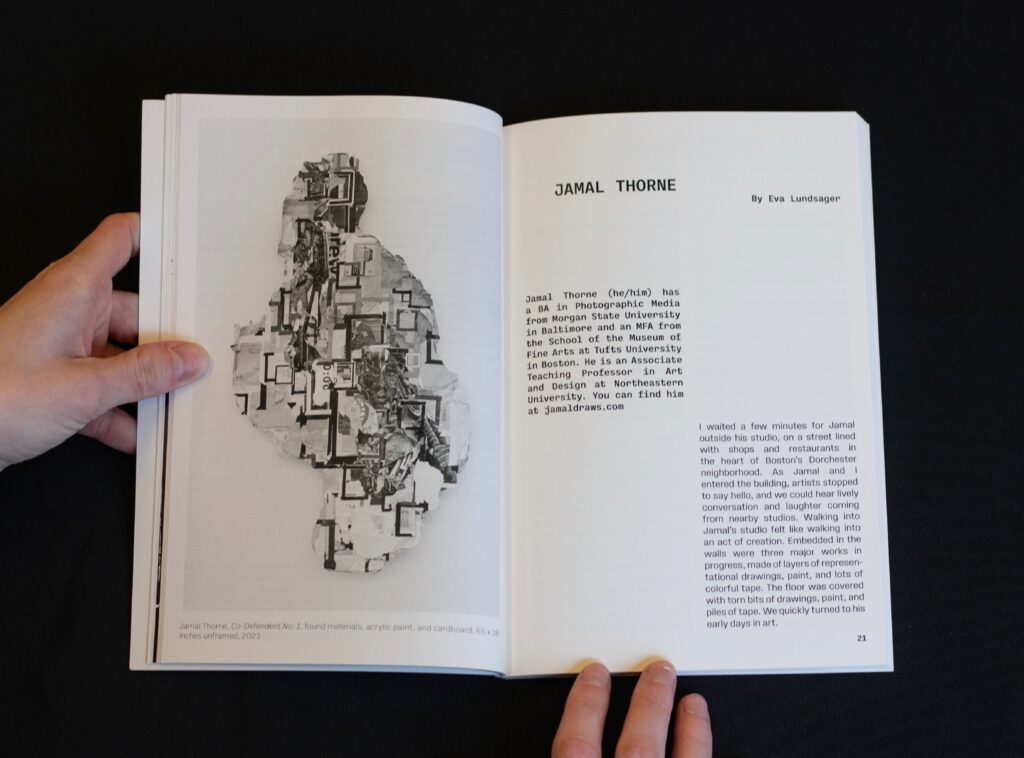
Two Artists Talking, 2026, Photo: Gwyneth Koeckhoven
When we first started this project, I was a student at SMFA in a class called Drawing Now, a seminar taught by Eva Lundsager. What took place in this class had little to do with ‘drawing’ and more to do with the ‘now.’ Throughout the semester, we learned how to conduct and edit an interview, making use of the resources on Voices in Contemporary Art’s website. Over time, a book started to emerge.
When the semester eventually came to a close, we didn’t have a clear solution as to how to bring the book into existence beyond a digital file that was designed by our classmate, Mrudhu Bhashini Vijayakumar. I knew the importance of the conversations that we had compiled and how much I would’ve benefited from reading them as a young artist in school. It felt like a small tragedy to have these conversations stuck unseen in a hard drive, never read.
I remember being in conversations with Eva and McCall Hollister (a friend and fellow student in Drawing Now), all stating what a pity it was that we couldn’t finish the project. Eva had spoken with several folks throughout Boston to see if there was any interest in publishing it in some capacity, but to no avail. So it sat, unfinished, until Eva, McCall, and I decided that we wanted to make this book happen, both for the sake of the artists who took the time to speak with the students, but also because we believed in the substance of the interviews and the value it held beyond a class project. When the three of us sat down, we had more questions than answers. What would the book look like? Where was the money coming from? Do we edit the interviews down? How much should we edit? How do we publish? How would we sell? Do we even sell? None of us had embarked on this particular journey before. So, despite the lingering questions, we began step by step, figuring out the answers to these questions as we went. We were bolstered by the words of the artists contained in the unedited transcripts, like Yu-Wen Wu’s advice to emerging artists: “[I]dentify the issues that really matter to you because with that we nourish a lifetime of work. We have so many things we may want to say and so many ways we can say it.” Or even more simply put, Deb Todd Wheeler’s words, “Sometimes getting started is the hardest thing.”
We spent almost a year editing the interviews. Our Saturdays and Sundays were spent hunched over a laptop at one of our houses, eating bagels and pastries while debating the use of italicized text or the capitalization of a word. Eventually, after countless read-throughs, the interviews were short enough and cohesive enough to be printed.
We then moved on to phase two: design. It turned into yet another year of work as we oscillated our focus from our full-time jobs to this project. Much of our time was spent formatting the text, doing more copy-editing, designing the cover, finding a printer, and deciding on the paper type. The list of decisions went on and on. The conversations on font size alone lasted longer than I could have ever imagined! Nevertheless, we pushed through. We knew from David Antonio Cruz’s interview that: “There isn’t a single right way to do this. You need to find out what works for you. If you create the work, you will be fine. Make the work.”
I think I can speak for the three of us and say that we felt a bit out of our depth, but the thrill of making this book a reality spurred us forward. It became clear how much we had to rely on one another’s different expertise. Much like Daniela Rivera’s relationship with her audience: “I never want to have viewers; I want to have participants. I like the idea of shared authorship even though I’m making the stuff.” We knew we had to collaborate with one another, but it was also a collaboration with the artists and students involved in the interviews, making sure the book rang true to the words inside. We divvied up the work where it made sense. Eva served as a great connector to those in the Boston arts scene and the artists we were working with. McCall had a thorough knowledge of book design and binding. I was able to contribute by pulling from my experience in design and editing interviews. It was a true lesson in collaboration and knowledge sharing.
By the end of this process, McCall had designed all the interviews into a print-ready layout, and I had designed several drafts of a cover. Eva worked to find funding opportunities, yet continuously came up dry. After much discussion, we were able to reduce printing costs by opting for black and white and limiting photos throughout with a more simplified design. It was at this point that Eva stepped forward to cover the cost of printing, and we were finally able to make this book exist physically.
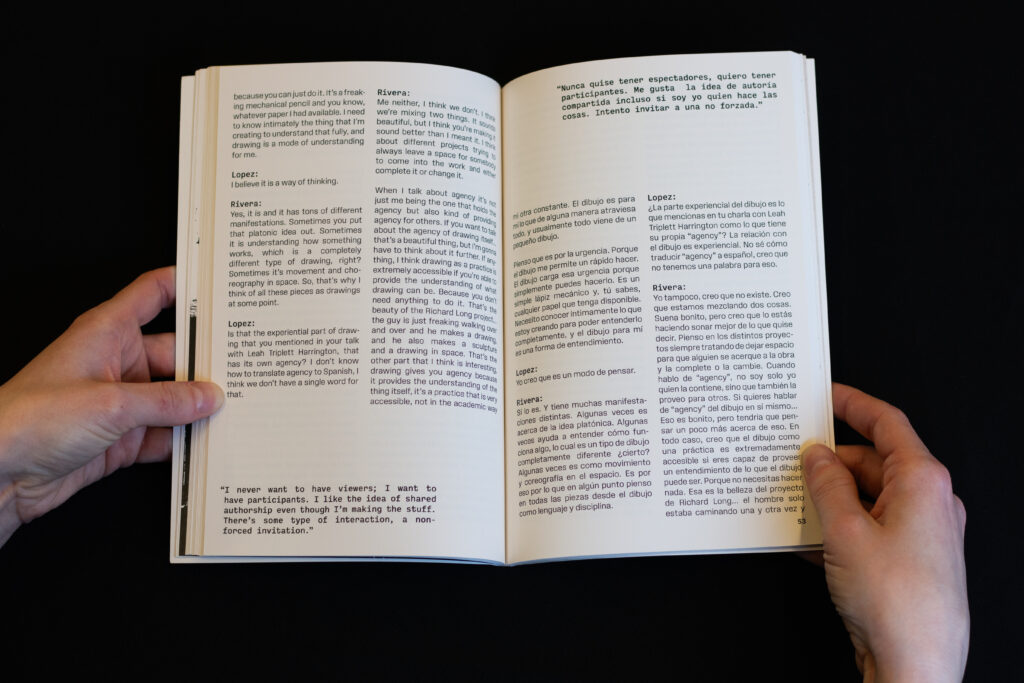
Two Artists Talking, 2026, Photo: Gwyneth Koeckhoven
Now, we have a book, a physical copy of Two Artists Talking that people can read and feel. Despite our lack of experience, we figured out how to make it happen. The process was a long and arduous one, but what we learned along the way was invaluable. We started from scratch and pieced our different knowledge sets together. It was a reminder that you don’t need to have experience or expertise, that this is how you learn: by doing. We made mistakes, corrected, tried again and again, going slow with the hope of getting it right in the end. Jamal Thorne was exactly right in his interview, “You’ve got to have faith in what you’re doing, and you have to recognize the value in what you’re doing, and you’ve got to be resilient.”
Through patience and determination, we were able to create a well-thought-out book and a sharply designed object that reveals the thought processes behind the artists’ work, as well as advice for emerging artists looking for a sense of community and belonging. It was a lesson for me that if I want to make something, to make it. Figure it out. Make mistakes. Get messy. Most importantly, work together.
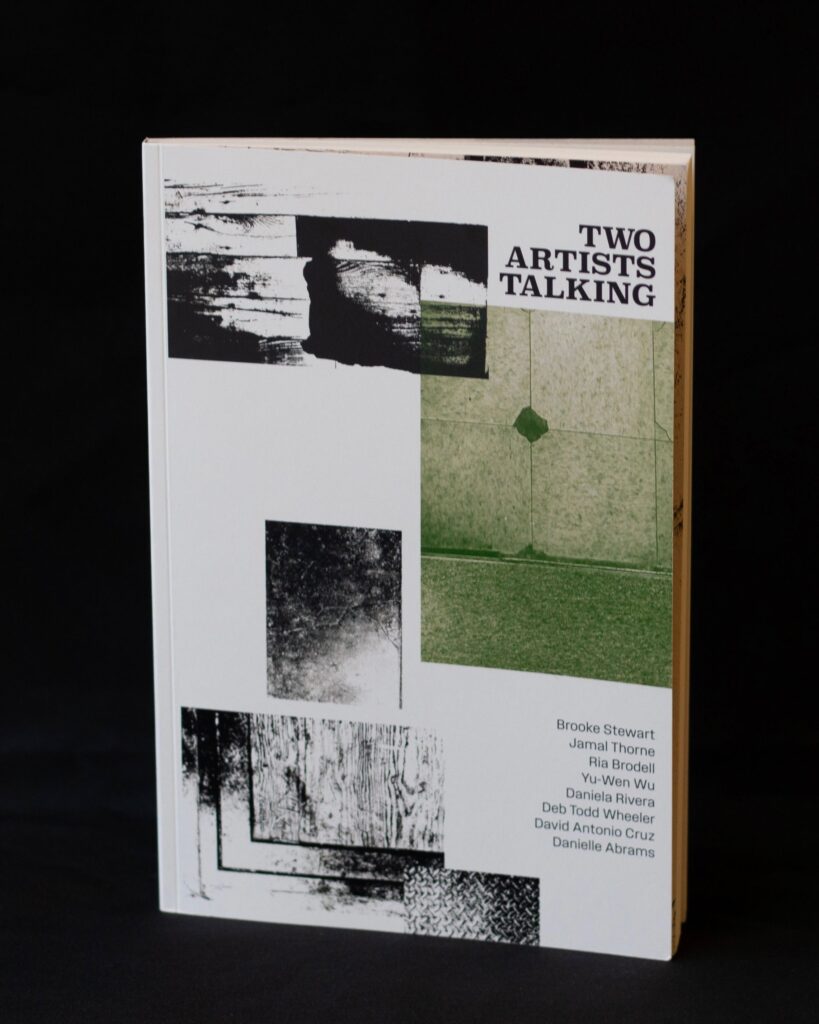
Two Artists Talking, 2026, Photo: Gwyneth Koeckhoven
You can purchase Two Artists Talking online or in person at Praise Shadows Gallery in Boston, the Isabella Stewart Gardner Museum gift shop, or in person at the ICA Boston gift shop.
PSG: https://artshop.praiseshadows.com/product/two-artists-talking/EIQRSFTU6KW3TU57MRKBJP2R
ISG: https://gift.gardnermuseum.org/products/two-artists-talking